
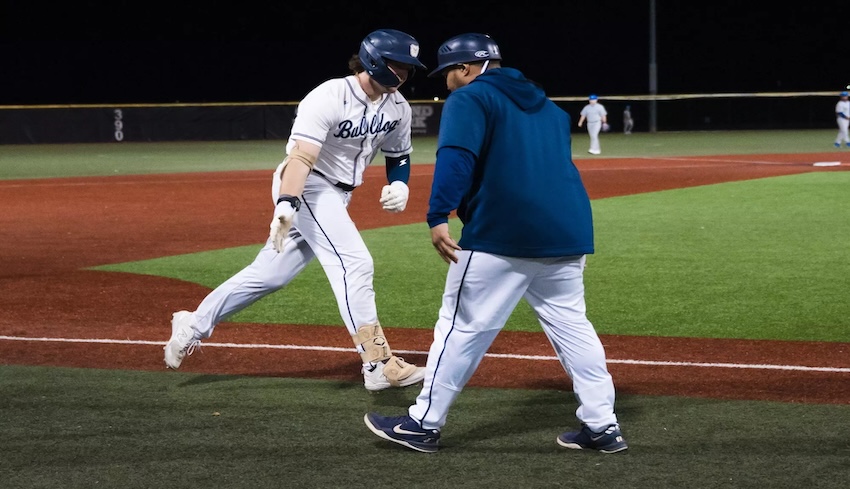
After making the jump from the National Association of Intercollegiate Athletics (NAIA) to Division I (D-I), junior first baseman Matthew Rhoades was unsure exactly how his game would translate.
About halfway through the season, the answer has been crystal clear: 15 home runs, a spot at the top of the national leaderboard and a solidified role as one of the Bulldogs’ most reliable bats.
Rhoades’ production has not come as a surprise to head coach Blake Beemer, who saw early signs of his offensive potential shortly after he set foot on campus. Beemer did note, however, that one can never be sure how a player’s game translates coming from a lower level of competition.
“We thought we were getting somebody who could really hit,” Beemer said. “[But] I think that’s always the question — will the numbers translate from an NAIA standpoint to a D-I standpoint? We were hopeful; we had seen the video, but until you see it against the higher echelon of pitching, you just don’t know.”
Early on, Rhoades removed much of that uncertainty. It became clear within the first week of fall practice that Rhoades had an advanced feel at the plate, particularly in his ability to control the strike zone.
Like many players making the leap to D-I, Rhoades had to prove to himself that his success at the NAIA level was not situational, but sustainable. Once that belief settled in, the results followed.
“I think early on, he showed that he understood the strike zone,” Beemer said. “He gets here in the fall, and you understand he’s got an advanced field to hit. He’s as ‘hitter-ish’ as I would say. So I did think early on that he would hit [well].”
The adjustment has been as mental as it has been mechanical.
Before arriving in Indianapolis, Rhoades turned in two stellar seasons at Concordia University in Nebraska, one of which culminated in the 2024 NAIA Ball Freshman of the Year award. Across those two seasons, Rhoades clubbed 35 home runs and boasted an elite 1.044 OPS. The lefty also spent part of those seasons on the mound, throwing 27.1 innings with a 2.96 ERA for Concordia.
Rhoades said the biggest challenge in his transition was not his swing, but his mindset.
“I’ve always been a pretty dominant hitter, so that wasn’t the biggest jump,” Rhoades said. It was more about getting over the mental aspect, the ‘I belong here and that I can perform at the highest level’ [aspect].”
The lefty’s understanding of the zone has translated into one of the top power seasons in the country. While Rhoades has emerged as one of D-I’s top home run hitters, his approach at the plate remains elementary.
“I wouldn’t really say I’m trying to hit home runs,” Rhoades said. “I’m just trying to put an ‘A’ swing on [each] pitch.”
Instead, the slugger’s focus is on hunting pitches he can drive and avoiding chase swings.
“[I’m] making sure I’m getting my pitch and not chasing the ‘pitcher’s pitch’,” Rhoades said. “So what if they throw a fastball by me? [My focus is just] being able to bounce back [in] those situations and get my pitch.”
That discipline has forced opponents to adjust. With Rhoades emerging as one of the most dangerous bats in the country, pitchers have become increasingly cautious. Rhoades has drawn 10 walks and been plunked by eight pitches. In recent weeks, pitchers have gone around the big bat and tried to exploit the boundaries of the strike zone.
Even that has not disrupted his process.
“These [pitchers] are human, they’re going to make a mistake,” Rhoades said. “It’s my job to capitalize on those mistakes that they make.”
That mindset — combining patience and confidence — has helped Rhoades handle not only success, but adversity to boot.
From Feb. 20 to March 1, Rhoades endured an irregular slump, collecting just one hit in a 22 at-bat stretch. That slump was punctuated by a demoralizing five-strikeout day at the plate against Marshall on Feb. 28.
For a hitter unfamiliar with prolonged struggles, it served as a test of both confidence and adjustment. Instead of letting this stretch deject him, Rhoades leaned on mental consistency and the support around him.
“‘It doesn’t matter, just keep swinging, good things will happen.’” Rhoades recalled Beemer telling him.
That response stood out to Beemer as much as any home run.
“For him to battle through that says a lot about who he has become this year,” Beemer said.
“Learning that just because you get out doesn’t mean it’s a failure of an at-bat. ‘Are we seeing a lot of pitches? Are we fouling balls off?’ When you hit so well for so long, you start to expect [success], and the game is just not that way. He just kept working, kept asking questions and weathering the storm, [we know] we can get through it if it ever happens again.”
Beemer remained confident in his first baseman, leaving him in the two-spot in the order despite the ugly stretch. That blend of self-awareness and confidence has elevated Rhoades from a productive hitter to the centerpiece in Butler’s lineup.
Rhoades’ presence has shaped how opposing teams construct their game plan. With one swing capable of flipping a game on its head, pitchers are forced into difficult spots — attack him and risk a ball leaving the yard, or pitch around him and give up a free base.
Either way, his impact is resounding. Rhoades’ value is not limited to the batter’s box. At first base, he has provided Butler with a steady defensive presence.
“He’s an above-average defensive first baseman,” Beemer said. “He moves pretty well left to right, he can really pick [the baseball] and he’s even helped us turn some double plays you don’t usually see. He’s been able to impact the game multiple ways.”
His infield counterparts have felt the same way, particularly through his communication and energy in the field. Junior infielder Charlie Schebler echoed what helps the Bulldog defense the most.
“He’s very vocal,” Schebler said. “[He is] very good at just building and keeping confidence all around and making sure the energy is there for everybody involved.”
For teammates, Rhoades’ impact extends beyond the box score. With 2026 being Rhoades’ third season of college baseball, he passes along as much as he can to his teammates.
“No matter what happens in his at-bat, the first thing he does is come up to someone who’s about to get ready for an at-bat and just gives us the rundown over what he saw,” Schebler said. “The first thing he cares about is making sure the guys who are about to go up to the plate have the best knowledge possible. It’s best coming from a guy like that who sees the ball that well.”
A team-first mentality has helped Butler’s slugger quickly earn the respect of a locker room filled with both returners and fellow newcomers. Off the field, teammates describe him as energetic and relentlessly competitive, a player who can shift from joking around in the dugout to locked in at the plate.
“He’s just a funny, goofy dude,” Schebler said. “Goofy dude, great guy [and a] great teammate all around. But when it’s time to compete, he’s more confident than anybody that he’s going to get the job done.”
Rhoades credited his loose but still competitive personality to his experience in backyard games.
“I’m really good at outdoor games,” Rhoades said. “Like spike ball, cornhole, ping pong, darts. I [also] enjoy playing hacky sack with the pitchers before the game, [it] gets the body loose, [and gives you a] good mindset, remembering that [baseball is] a kid’s game.”
That personality has allowed Rhoades to settle in seamlessly, despite arriving as a transfer. His transition was made smoother by an unexpected connection — Rhoades and Schebler were roommates upon arriving on campus, quickly building the kind of chemistry that now shows up both on and off the field.
Beemer said the junior’s willingness to embrace the program and invest in his teammates has been just as valuable as his on-field production.
“He’s a joy to watch,” Beemer said. “He smiles, he bounces around, he enjoys playing baseball. He’s really gone all in on Butler and what we’re trying to do here.”
Rhoades’ scorching start to the season helped earn him Big East Player of the Week honors on March 9, a week where he hit for an unfathomable .563 average, adding five home runs to boot. The lefty has also received national attention, being ranked on D1Baseball’s Top 50 First Basemen list six weeks into the season.
Through 25 games in the 2026 season, Rhoades has slashed a .309/.414/.845 — average, on-base percentage, slugging percentage, respectively — leading the team in home runs, extra-base hits and slugging percentage by almost .200.
Rhoades currently sits tied for second for home runs in D-I with 15, only trailing Cincinnati’s Quinton Coats.
Several of his biggest swings have come in momentum-shifting moments, with six of his long balls being lead-taking blasts. These clutch moments reinforce the sense that every time he steps into the box, Butler has the chance to change the trajectory of a game.
As the Dawgs push toward conference play, Rhoades’ emergence has provided the Bulldogs with more than just a top-of-the-lineup bat. It has given them a stabilizing force — a more-than-capable hitter, a defender steady at first base and a teammate who makes those around him more prepared.
For a player who was once questioned on whether his success would translate to D-I, the answer has echoed across college baseball.
Nearly halfway through the season, Rhoades has not just proven he belongs — he’s established himself as one of the most dangerous hitters in college baseball.
“It sounds simple, but man, Rhoades really enjoys hitting,” Beemer said. “He’s got a confidence that only comes from doing something you really enjoy doing, and again, [he has] the confidence in the [batters] box, [and] understanding of who he is in [his] swing.”