
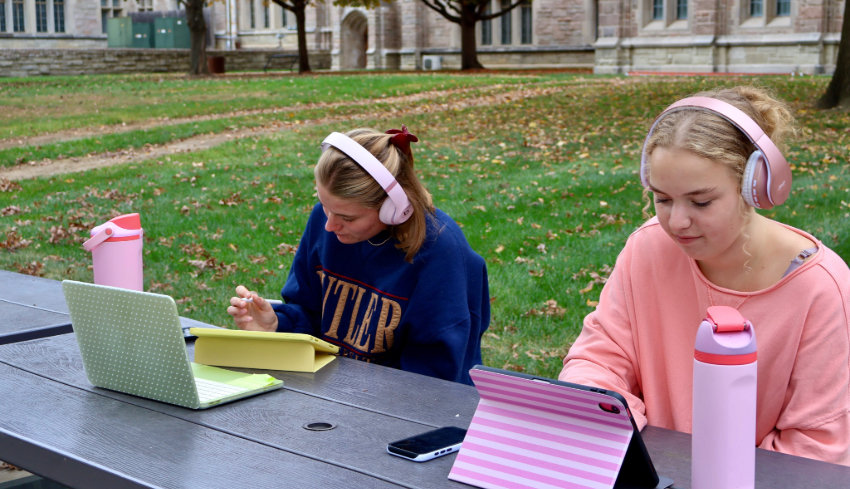
Our lives are unbelievably packed to the brim with extracurricular activities, relationships, familial duties, part-time jobs, oh yeah and don’t forget the expectation to complete two or more hours of homework per credit, per week.
The average full-time Butler student takes 12-15 credit hours per semester, which means we’re expected to complete 24-36 hours of homework in one week. The math isn’t mathing.
I don’t know about you, but to me, an entire day’s worth of just homework is maddening. I’m an English major, so having to read one novella in one day is practically lightwork. I can’t imagine 24 hours worth of math or biology homework.
First-year pre-pharmacy major Tyler Becker discussed how many hours of homework he typically has in one night. He highlighted that some of his science-focused classes assign more nightly homework compared to others.
“Per day … I’d say about two to three hours, depending on if I have my chemistry class that day, [if so] it will jump up a bit more,” Becker said. “I’d say [I have] probably over 10 hours per week … [during the] weekend, [an] hour or two at most unless I have a project I’m working on.”
I was quite surprised by Becker’s responses. I assumed any science major would have at least 30 hours of weekend homework. I suppose it is nice to see that, at least for Becker, professors assign less weekend homework, as opposed to homework due during the week.
I’d like to think Butler professors are not just handing out homework assignments to make us sleep-deprived zombies. However, the benefits of homework do not outweigh the stress it puts on us.
Honestly, showing up to class is hard enough. Sometimes it feels impossible to get out of bed for an 8 a.m., when I’ve stayed up until 2 a.m. just completing homework. If I didn’t have to worry about homework for my classes, I would be more willing and awake to participate and be actively engaged in class.
Education professor Susan Adams only assigns “out-of-class assignments” when she knows it will benefit her students, not just waste their time. She believes if giving students homework is not actively deepening their understanding, then it shouldn’t be assigned.
“From a professor’s perspective, the time we have together in class is not enough to do everything that needs to be done,” Adams said. “Universities are expected to build courses with sufficient units of time … we’re supposed to make sure that you’re working inside of class and outside of class.”
I do understand Adams’ perspective because while we are at the mercy of our professors, they also have demanding expectations being pushed onto them. It just so happens that giving out homework is not entirely in our professors’ control.
“There is some research to defend some of the practices you’re probably experiencing in cultivating your ability to retrieve and recall particular information or process,” Adams said. “You would really like your future doctor to know something about the way the body works … How do they know to tell people that? Well, they study. We give them a test and they demonstrate they have proficiency. Some of that just needs to be done outside of class.”
Homework can benefit college students by growing retention, challenging and deepening our understanding, as well as advancing our time-management skills. It is, allegedly, a tool used to reinforce the material already taught in class. It also strengthens our critical thinking skills.
So homework is good for helping us process information better. What’s the big deal? How are we supposed to effectively, not just complete, but comprehend homework when most of our lives are jam packed with a dozen other commitments and we are sleep-walking to class?
American college culture has created this expectation that an average college student should take at least 15 credit hours, exercise every day, have a booming social life, a routine sleep schedule, take care of our mental state, have “good” grades, study every night, pass every assessment, have an on-campus job … Need I say more?
I understand that school is our top priority right now. I mean that is literally why we’re here: study hard, work hard, get the degree and hopefully have a sustaining career for the rest of your life. I am not disagreeing with this, but I am saying that the university experience we have normalized and adopted asks too much of students.
The average college student spends three and a half hours completing homework each night, with 94% of us reporting high levels of stress. The more hours of homework we have, the more health problems we are beginning to see within ourselves: symptoms like trouble sleeping, mood swings, headaches, stomach problems, decreased self-esteem, irritability, fatigue and the desire to avoid doing any homework at all.
It is unrealistic to ask Butler to completely ban homework on campus. However, significantly decreasing the homework load per day, week and especially on the weekends, would definitely relieve the chronic stress that has befallen us all.
French instructor Ouafaa Deleger is a professor that generally does not assign homework. She encourages students to study grammar and vocabulary daily, though.
“There is almost no point in giving homework because you realize pretty quickly that a lot of students are using [the internet], and I’m not condemning it,” Deleger said. “That’s normal when you are overwhelmed with all the homework, that suddenly you’re going to use either Google translate, or AI or whatever to help you with your homework.”
Perhaps we are using the internet for homework help because we are lazy. Perhaps it’s because of the storm cloud of pressure relentlessly pouring on us. If we don’t do “good” on our nightly homework assignments, our grades will take hits every single day.
We’re never going to not have homework. Even in the corporate world, we will often have work to complete at home. That being said, I urge professors to please reevaluate exactly what it is that you’re assigning your students each night. Ask yourself, “Will this genuinely contribute to their comprehension?”; “Is this something we could just complete in our next class?”; “Is this homework necessary or should I make it optional?”
Perhaps instead of lecturing during the whole class meeting, professors should consider giving half their lecture/seminar time to completing the homework in class, in order to relieve some of the stress we will inevitably feel later that evening.
The fact is that excessive — and dare I say unnecessary — amounts of homework are doing more harm than good. While there are benefits to homework, such as advancing retention and helping practice time-management skills, the cost of my mental and physical health is not a price I am willing to pay.