
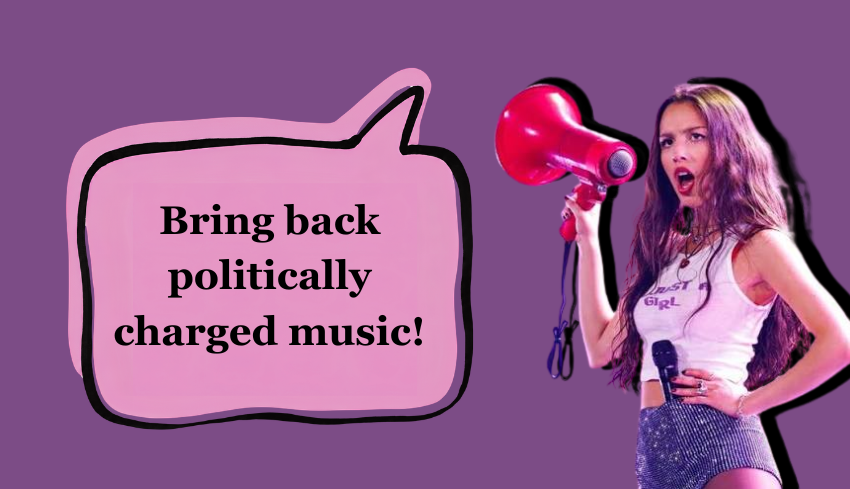
Music is an art that can describe almost anything a person is going through. Songs can tell stories, express feelings and let artists speak out against political and environmental issues to create tangible impact. Overall, music naturally reflects our world culturally, personally or politically.
The music industry has shifted with record labels and radio stations prioritizing revenue over spotlighting artists who speak out against oppression or politics because it’s seen as too risky or niche. Music that makes statements is just as important, if not more, and we need to start spotlighting artists that express their views through their songs no matter how “risky” it may seem.
Butler has put a great emphasis on the importance of music with their many programs within the school of music. Here, professors and students express themselves creatively, with an added layer of knowledge on how music shapes our world.
First-year music education major Lillian Jackson discussed how music can be utilized as a tool in order to reach people.
“Music is a way to bring a bunch of people together,” Jackson said. “I think it is a way for people to also express themselves in very hard situations, which I feel like is pretty straightforward.”
To pursue a Bachelor of Arts in Music or Bachelor of Music at Butler, undergraduates are required to meet the core learning outcome of demonstrating broad knowledge of music in diverse, cultural, historical and social contexts. This emphasizes the importance of how music is a tool for empowerment, and how music has been a way to guide society towards change for many generations.
First-year music education major Calvin Mackey explained how music can be a tool for liberation.
“We have to embrace change because it’s not going anywhere,” Mackey said. “Some music has genuinely shifted my entire perspective about how I look at the world. We never get to see the full story of conflicts behind closed doors, and that representation … We are constantly changing humans in a changing world and we need people who are brave enough to put music out there, whether it’s cryptic or just blunt.”
In a time when change is rapidly occurring with artificial intelligence, tense political atmospheres and environmental changes, music with powerful messages is necessary because it is a way to tell a meaningful story or an impactful message.
“serena joy” by Olivia Rodrigo is just one example of a song with a strong activism background. Serena Joy is a character in “The Handmaid’s Tale”, who is often seen to “ignore” the mistreatment of women within a dystopian society where women have been stripped of their autonomy.
“Yeah, it’s all for the cause / For the good of us all / And if you close your eyes / Then it can’t be your fault,” Rodrigo opens the song with these lyrics, sparking debate about how not speaking up about issues in our world can be detrimental and how people often ignore important political issues rather than speak out in fear of being “ridiculed.”
Sophomore health sciences major Chloe Shadiow talked about her thoughts on the new release.
“There are a lot of women who are upholding the patriarchy and centering men in their content or trying to devalue feminism,” Shadiow said. “I think that right now is a really good time for her to make [“serena joy”].”
Rodrigo emphasizes public blindness to social issues and the idea that our generation refuses to look at suffering, which allows privilege to persist. This song made it so her fans could discuss uncomfortable subjects in a way of connecting and decoding music.
Manon Voice, professor of hip-hop and culture, discussed the intersection of activism, capitalism and music in today’s world.
“Music has always been a vehicle for testimony, resistance and collective memory,” Voice said. “I think we are living in a time that feels more urgent because of the number of crises we are in sociologically. I think it is a time where artists particularly feel compelled to use their voices to speak truth to power.”
Now more than ever is when we need to put a focus on music that is “risky” with an actual stance and voice, whether that be against oppression or our government. Music is a powerful tool that produces important discussion with our peers.
“I think the way we discover, distribute and consume music has changed dramatically, and I think sometimes that is what influences cultural norms,” Voice said. “It’s up to us to keep pushing back against that rhetoric.”
Songs that you should listen to in this day and age are: “Alright” by Kendrick Lamar, Bob Dylan’s “Blowin’ in the Wind”, Annabella Dinda’s “The Hand”, “New America” by MARINA and Sofia Isella’s “Us and Pigs.”