
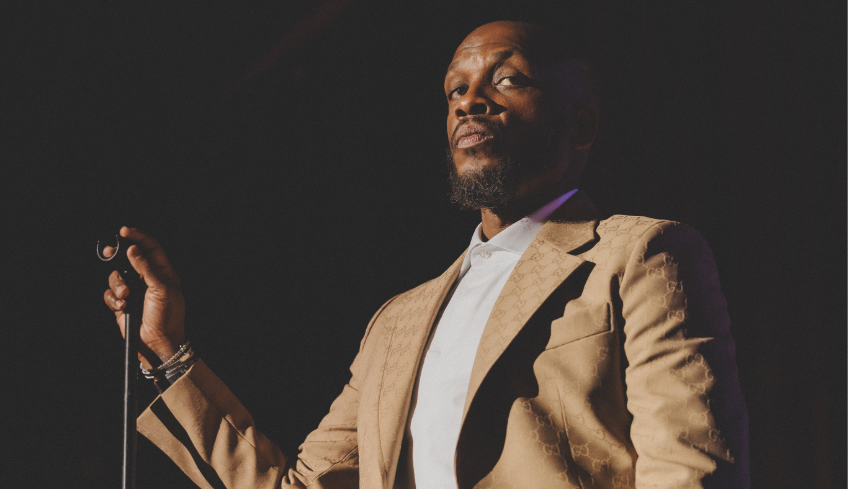
Ali Siddiq tells stories from real life. After facing six years in prison for trafficking cocaine — or as he puts it, being a “street pharmaceutical rep” — Siddiq has some pretty funny stories. Crowned by Vulture as “stand-up comedy’s most prolific storyteller,” Siddiq has steadily gained mass amounts of recognition for a personal narrative style like no other.
Siddiq possesses the unique ability to make even the darkest moments — like a riot in jail — something worth laughing at. His new stand-up special “MY FATHER” premiered on his YouTube channel on June 21 and already has over four million views. The Collegian sat down with Siddiq to talk about his upcoming show, generational differences in comedy and his journey as a comedian. Siddiq will perform at Clowes Memorial Hall at 5 p.m. and 8 p.m. on Saturday, Oct. 24. Tickets are available for purchase online.
THE BUTLER COLLEGIAN: Can you tell us a little bit about what to expect from your upcoming Indianapolis performance?
ALI SIDDIQ: Some new experiences, some new stories. If you’re familiar with me, then you know how I move. But if you’re not familiar with me, I suggest that you go on YouTube and get acclimated to how I do my thing. I just put out the greatest hits for ‘The Domino Effect’, but you can go down the rabbit hole and watch all the specials. But I will not be doing the stories from any of the specials. I’ll be doing new stories.
TBC: Your storytelling is very unique and has a strong personal narrative style. Was there one particular person who you learned to tell stories from, or is that all you?
AS: That’s my family. It’s no artist. It’s my grandmother, my mom, my uncles, my dad. That’s how I’ve learned everything in my life. It was ‘Hey, come here, let me tell you a story,’ whether good, bad, indifferent or just informational. I think a big part of my style [comes] from a family of people, like most people. Somebody in your family told you stories about your family — however that style was that they told you the story in. My uncle told very fascinating and embellished stories, and my grandmother told very informational stories, and my mom told very direct, serious stories. My dad was a little more jovial than that. It’s all the people in my family. Everybody had their own style, and I got an opportunity to listen to all of it.
TBC: Do you think the internet has changed comedy for the worse or for the better, or is it too hard to say?
AS: The worse, really … I think that every skill set is starting to understand that that’s what it did. At first, it was this whole, ‘Everybody’s a comedian, every person that makes somebody laugh is a comedian.’ … Everybody was okay with it, but if you cook something on the internet, that does not make you a chef. If you do an interview with somebody, that doesn’t make you a journalist. So now, people are starting to understand. If you decide that you’re going to go somewhere, you’re going to try on clothes from different places — that doesn’t constitute being a model.
Now that other people’s skill sets have been infiltrated, they understand that it’s not the same muscle. I think that the internet has [created this idea that] it’s easy to do anything. You don’t have to actually go to school for it. You don’t actually have to be in the industry. You don’t actually have to do it. Turn your phone on and whatever you say you are, you are.
TBC: You also do something I really appreciate by having very deep conversations with people. You aren’t just a comedian. You had a sit down conversation with inmates about incarceration. Why do you think it’s important to also have a serious presence as a comedian?
AS: When you think about stand-ups in general, you have people who had very political standards of information. You have people who have historic standards of information. Then you have the people with just the common sense [version] of things … You can be funny within common sense. I remember this comic, Billy D. Washington told me, ‘Hey, when you’re not being funny, be interesting.’
… With the prison, [the] thing is, I can give you insight that somebody else cannot give you. [Someone] that’s never been in the position [can’t] help you as a prisoner on how to navigate once you get out, or even [help you] start navigating [on the] inside. But if you look at somebody who came from the same condition that you came from and managed to navigate a different role for themselves — then that’s a different conversation.
TBC: You’ve mentioned you worked a lot of different jobs to get you closer to stand-up after you got out of prison. Could you tell me a little bit about those?
AS: I worked in customer service. I worked as a janitor. These were things that I needed to do. In comedy, you don’t start to get paid until way later.
… Crowd work in my era was something that you did when you didn’t have material. It’s like when you didn’t have material because it’s the easiest thing to do. I know people will try to say different, but it literally takes me no brain power to do crowd work because I’m not doing anything but saying where you went to school at, where you did this at, where you work at, when y’all met. This is a general question. Now, I’m interviewing the audience.
It’s so easy that it becomes frustrating that you put that as a part of the craft. It’s like painting by numbers and then saying, ‘This is a Van Gogh, this is a Picasso.’ No, you painted by numbers.
I’m from an era [where] people could critique people for the best. If somebody said, ‘Hey, man, this is your best special.’ I would disagree. Because I don’t know what my best special is yet. I’m still working. I’m not a finished product.
TBC: Who are some of the greats that you want to shout out?
AS: I hate that a lot of them [are] dead. Carol Burnett is great. If I ever had the opportunity to sit down with [her], I would. Cosby is a great. If I ever had the opportunity, I would sit down with him. I had the opportunity to sit down with D.L. [Hughley]. That’s one of my mentors. And Don Rickles, if he was alive, I would sit down with Don Rickles. Sammy Davis Jr., for different reasons, you know. Or Rodney Dangerfield, I would love to sit down with Rodney Dangerfield.
I would sit down at this dream dinner with a lot of different people for a lot of different reasons — because people have a lot more to offer.
TBC: What do you think would help the younger generation? What part of your craft would you encourage the younger generation of comedians to try to practice?
AS: Don’t skip any of the steps. The craziest thing [is] they will idolize somebody who did all the steps … To know the fundamentals of how this craft works [is] to navigate through those hard places, which gives you a better understanding of the craft. The process is in the mistakes.