
Content warning: Explicit mentions of sexual assault and violence.
There are stories that make us angry. There are stories that make us uncomfortable. Then, there are the stories that make us look around our environment and wonder, “What would we do if this happened here?”
For me, the Cornell case is one of those stories.
A former Cornell student, who identifies as Jane Doe in court documents, alleges that she was sexually assaulted by multiple members of Cornell’s chapter of the Chi Phi fraternity in October 2024. The allegations have since resulted in a lawsuit against Cornell, the fraternity and the seven men allegedly involved. Three out of seven men have defended themselves and denied wrongdoing. The criminal investigation has now been reopened.
What makes this case even more disturbing is what happened after the alleged assault.
According to documents from Cornell’s investigation, a Snapchat message was sent to a fraternity group chat that included approximately 50 members. That message suggested that there was a woman in a room available for sex. Multiple men from that group chat responded to the first message.
That detail is difficult to ignore. 50 men were involved in that conversation, yet not one single man stopped it, openly questioned it, called the police or chose to protect that woman. Where was the person who recognized something was wrong and decided that fraternity status was not more important than a woman’s safety?
I cannot speak for every person in that group chat, and I do not know what every individual knew or understood on that night but as a college student, I find the existence of that conversation incredibly upsetting.
Cornell’s internal disciplinary process did result in consequences for the “men involved.” Two were expelled from Cornell. Two received suspensions. One man, who had already graduated, was banned from campus for three years. Two others were told to write a reflection paper and attend an educational bystander-intervention training. The Chi Phi chapter at Cornell was also shut down.
Personally, I struggle to look at these consequences and think they represent accountability proportionate to the allegations. What troubles me most is the apparent gap between the severity of the allegations and the range of consequences that followed. The lightest consequence was writing a paper and completing educational programs.
A paper cannot undo trauma. A training session cannot erase what someone says happened to them. A university sanction cannot give someone back the feeling of safety they may have lost.
That is why I think colleges need to ask a harder question than, “Did we technically punish someone?” Rather, they should ask, “Did our response communicate that this behavior is completely unacceptable?”
The seven men named in the lawsuit receive most of the public attention, as they should. I can’t help but think about the other people who were in that group chat, though. There were about 50 fraternity members in that Snapchat group. That number makes this situation feel larger than seven individuals. It changes the entire matter and becomes a question about culture.
I am angry thinking about the possibility that dozens of people saw the message and not one stepped forward to make sure the woman was safe. Again, I do not know what every person in that chat knew and I do not know everyone who was present or what each person did afterward. That uncertainty, though, does not make the broader question disappear.
College students and young adults love to say “that’s not my business.” In this case, though, it absolutely is. If you see someone who is vulnerable, you have a choice. If you see someone in danger, you have a choice. All these men doing nothing is a choice too.
Now, we translate this situation to Butler. Butler students should stop treating Cornell as someone else’s problem. Butler is not Cornell, and our Greek organizations are not Chi Phi. What happened at Cornell does not mean something identical is happening at Butler.
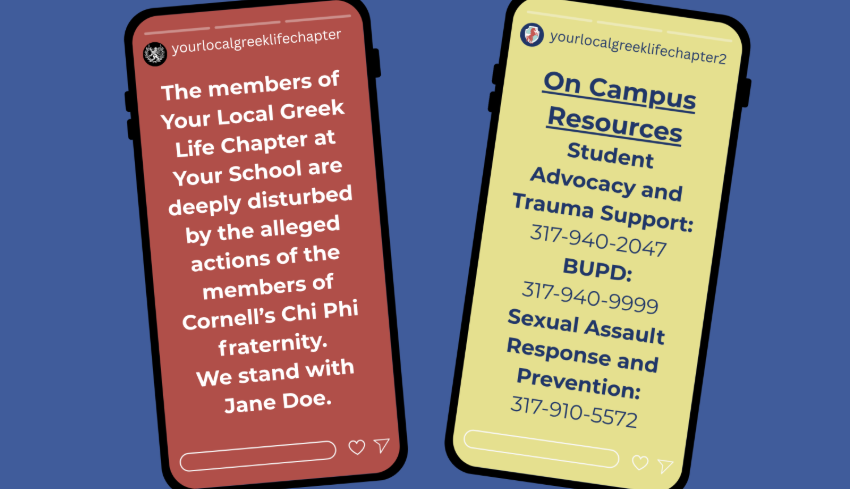
That being said, we shouldn’t wait for something terrible to happen before we decide what our standards are and should be. Several Butler fraternities and sororities have posted statements expressing support for Jane Doe and emphasizing their organizations’ values.
While I appreciate seeing Greek organizations speak up, I think we need to also ask what happens after the Instagram story expires. If an organization says it supports survivors, what does that truly mean? Does every member know what consent means? Does every member know how to intervene when something feels wrong? Would a fraternity member here feel comfortable risking his friendship in order to do what is right? Most importantly, would students believe that their campus would take them seriously and provide them justice?
For Butler sororities, that responsibility starts with holding members accountable, even when doing so is uncomfortable.
Junior health science major Sydney Baker, who is a sorority risk manager at Butler, emphasized that friendship should never come before another person’s safety.
“You have to hold your friends accountable even when they’re doing something wrong,” Baker said. “You shouldn’t put someone’s needs over someone else just because they’re your friend.”
We need more than statements. I don’t think posting “We stand with Jane Doe” is meaningless because survivors deserve to know that they are believed, supported and not alone. However, after this case stops being “trendy,” we shouldn’t stop caring and raising awareness of sexual assault.
Although words are only the beginning, I am happy to say that all Butler fraternities and sororities are required to do modules or training sessions regarding sexual assault and how to handle it within Greek life. It is so important to have these uncomfortable conversations, teach members how to intervene and talk about consent before something goes wrong.
Jason Hasler, a junior finance and risk management double major, who is the risk manager of Delta Tau Delta, says the chapter reinforces the importance of bystander intervention through Green Dot presentations, which teach fraternity members how to safely intervene when they witness concerning behavior.
“It can be tough when it’s your own friend,” Hasler says. “At the end of the day, we’re all our individual person, and we represent the house as a whole.”
There is also responsibility on the university. I think Butler and Butler University Police Department (BUPD) do a great job at providing resources for victims, as you can find the most common resources on the back of every student ID card. Butler’s Office of Student Advocacy provides confidential support for students experiencing sexual misconduct and can help students explore and understand what options and resources are open to them.
Knowing these resources exist is important but knowing how to use them is even more important. Butler University Police Chief John Conley emphasized that students should not hesitate to reach out to BUPD when they are unsure how to handle a situation.
“If you’re in doubt, call us; call BUPD,” Conley said. “The one thing we always want to do is to make sure that whoever is a victim in something like this has access to the proper resources.”
He explained that officers can help students toward the appropriate resources depending on the incident, whether that involves law enforcement, Student Affairs or Title IX.
Conley also stressed that supporting survivors means allowing them to make their own decisions about reporting.
“We don’t ever want to force somebody to say, ‘I’m going to prosecute you for this,’ but we want them to know what their options are,” Conley said.
The Cornell case has made me angry. I don’t want that anger to stop at social media posts, arguments in group chats or conversations about how horrible the situation is. I want it to make us think about ourselves. Would you have been bold enough to step in? Are you willing to listen to a friend in need? Would you care more about your organization’s reputation or protecting another person?
Although these are uncomfortable questions, they are necessary because the goal shouldn’t be to figure out how Butler would respond after a tragedy but it should be to create campus culture where students understand that sexual assault is never something to laugh about, ignore or excuse. The goal should continue to be creating an environment where students feel empowered to intervene before a situation becomes a tragedy.
Cornell’s investigation is still unfolding. The seven men have not been charged criminally yet and the allegations still remain allegations while the legal process continues.
Butler should not and will not wait for another case to make these conversations happen. We can have them now. We can hold our organizations accountable and learn how to protect one another now.
The most important lesson from Cornell that all Butler students should be applying is that when you see something wrong, don’t be the person who says nothing.