
Members of the Butler community are achieving extraordinary things, both on and off campus. From first-years to alumni to administrators and back, each Bulldog has a story to tell. Read on to discover the next of our Bulldogs of Butler through a Q&A style interview.
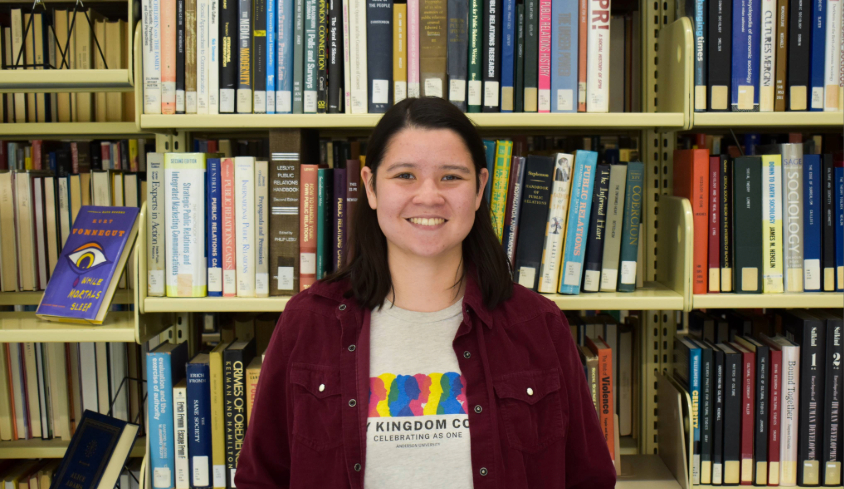
For some, education never truly stops, whether that is as a student or a teacher. This is especially the case for Anna Pescio, who balances working towards an M.A. in English with teaching the very same subject. Pescio teaches kids all the way from sixth graders to high school seniors, all while attending night classes at Butler to expand that teaching in the future. The Butler Collegian sat down with Pescio to learn more about what it is like to be both a student and a teacher.
THE BUTLER COLLEGIAN: Do you have a favorite grade level to teach?
ANNA PESCIO: Definitely older — I’d say juniors and seniors the most. I really love the way we can go deeper into content at the higher age level. I feel like they take the content more seriously and they get a lot more out of what I’m teaching … They have a lot more insightful ideas to bring to discussion or in their writing when I’m working with them.
TBC: How have you found the experience of simultaneously being a student and a teacher?
AP: It makes my schedule a lot busier, but I have always really enjoyed academics, and I love learning. It’s really nice to be in an environment where I can be a student again and take in, absorb, contribute to discussions — not just lead others in discussion.
TBC: Have you found that you have learned a bit more about how to teach from being a student or vice versa?
AP: I would say as of right now there hasn’t been a lot, but it’s also my first course, and it’s a film course, so with that, there’s a little bit less that I’m able to transfer over. The biggest thing I’m working with my high schoolers right now on [is] how to generate good discussion questions, so that’s one thing that I’ve worked on before. I’m also pulling from what we’re doing in the course [to learn] how [to] ask good questions [and] what types of questions are going to lead to good discussion.
TBC: Are you taking any specific lesson content that you experienced as a student into your teaching?
AP: From my undergrad, I learned a lot when I was student teaching, both in actual curriculum and also how to manage a classroom well, which I’m still learning and still working on. There’s a lot of skills I pulled from that. I did a “Macbeth” unit, and that was really fun. I was able to bring that in with my students last year, and it’s given me some ideas of other things I want to do this year. Also [from] my undergrad, which I want to explore more in my master’s as well, is [the idea of] diving into multicultural and multiethnic literature and trying to find little ways to incorporate some of those types of stories with my students who are predominantly white. I have a mix of Hispanic and Black students as well, and I like being able to pull in stories that they can relate to and stories that they can learn from.
TBC: What is your favorite piece of literature to teach?
AP: This is only my second year teaching, so I haven’t taught a lot, but one that I have taught that was really fun was “Macbeth”. I also taught “The Hunger Games” last year, which was really fun. Students got really into it. [A book] that I’m looking forward to teaching this year is “The Great Gatsby” — as a student, I’ve read that novel three different times for three different classes. There’s a lot you can learn from it, so I’m really excited to teach that one this year.
TBC: How does being a master’s student differ from being an undergrad student?
AP: It honestly doesn’t feel that different. I think the main difference is the confidence that I feel in the classroom. I feel like as a master’s student, because I have experienced discussion-heavy classes and literature-heavy classes, I have a stronger base to start from. Being in higher-level classes, you’re able to go a lot deeper than you can with intro courses where we’re dabbling in five different novels from all across the board. [I could not] really focus on one author or one work [in] some of my undergrad classes, [which] you’re able to [do in] the higher-level courses.
TBC: What are you hoping to get out of your master’s program here?
AP: Just to be in academics again, because I love it. I [want] to eventually move into teaching undergrad, so it’s one step toward that career path. In the near future, I’d like to change where I’m teaching in order to be able to teach dual-credit classes as well. It’s both wanting to learn more as a student and just be in academics, but then also long-term furthering my career.
TBC: You mentioned that you really enjoy being a student. Could you expand on that?
AP: Yeah, I think there’s something about being able to encounter a text or a piece of media for the first time and be able to [ask], ‘What does this mean? What can I learn from it?’ To be in a class full of people and discuss — people have such wildly different perceptions of the same thing, so being able to learn not only from the professor, but learn from each other and be able to explore a text in that way. It’s a different set of brain muscles than when you are super familiar with a text and you’re trying to guide students to get certain things out of them. You want them to generate their own ideas, and often there are certain goals that you’re shooting towards. [As a teacher], you’re the one who’s meant to be the master of that knowledge. It’s fun to be able to explore new things that I haven’t really encountered before.
TBC: You said that you teach a lot of juniors and seniors, and being in the college environment, you’ve seen a lot of people not much older than your students as your peers. How has that been for you?
AP: It is interesting because I only took a year off between undergrad and grad school, so I am very close in age to a lot of my students and also to my peers. The different setting helps me separate those two things, but it definitely is strange sometimes when I think about how old these people actually are — I’m like, ‘Oh, we’re not that far in age. You’re my student, but people your age are my peers.’