
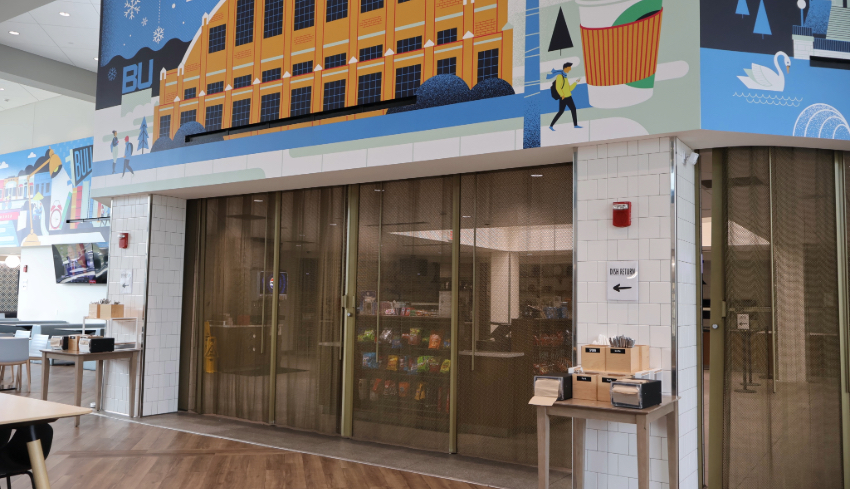
It’s the start of the weekend here at Butler, and you are starving. Quickly, you realize a singular dining hall is open, and none of the food options sound particularly appealing.
Friends and students complain to each other about where to eat on weekends and whether money should be spent at places like McDonald’s, Chick-fil-A or Taco Bell. However, instead of complaining to our friends, we should start exclaiming to Butler staff who can actually make a change to our weekend dining options.
Improving weekend dining options requires more than complaining to each other about wanting ResCo or A-Town Market to be open; real change requires students having meaningful conversations with dining services such as Bon Appétit or even the Butler Dining Committee — a student organization.
Students engaging with Butler Dining and improving business on weekends can identify demands and help with the limited food options on weekends.
Dining options, especially when it comes to quantity, have been a hot topic between students for quite some time. I have personally experienced the limitations of weekend dining. On Saturdays and Sundays, A-Town Café is typically open for brunch, as well as dinner. Meanwhile, A-Town Market is only open during select hours. ResCo is entirely closed.
Mckenzie Markus, a sophomore theater and psychology double major, shared her opinions on Butler dining during weekends.
“I want to eat certain foods that aren’t necessarily available, or that are better quality than some of the A-Town food, because there’s such a variety,” Markus said. “Sometimes quantity is looked over more than quality.”
The demand is there, and students have persuasive arguments to back up their reasoning as to why more options should be available on weekends. For example, limited food options may mean that a student may not want what is available, but they do not have the means to spend money on a fast-food chain. Nonetheless, these arguments are only spewed to friends and classmates, not to those who can actually make our voices heard and understood.
Bon Appétit and the Butler Dining Committee says they strive to enhance different meal options for students based on the type of traffic and engagement that they acquire. Dining operations are a complex system based on many different factors; they cannot simply augment a fast food chain for our convenience. These efforts take time, commitment and research.
Matthew Barnes, the director of operations at Bon Appétit, explained why not as many food options are available on weekends.
“We are always open to feedback through the dining committee, through surveys and direct feedback forms,” Barnes said. “We typically use historical patterns as gauges to where students are and students’ needs for dining; we base our operations off of those patterns and the feedback that we get.”
These historical gauges tell Bon Appétit that most students are not around on weekends; they simply do not have enough business to justify keeping ResCo and A-Town Market open.
Businesses operate based on metrics, data, Quarterly Business Reviews and a whole lot of analysis. I understand the need to complain about operations; however, I feel that as students, we should approach these issues within Butler a lot more critically and understand that this is a full-blown business operation doing its best to adhere to all students’ needs.
Dining committee vice president Emilee Theofanopoulos, a senior mechanical engineering and environmental studies double major, spoke out about the little feedback that they get when it comes to student engagement.
“We want student feedback, but we didn’t really see a great way to do that,” Theofanopoulos said. “We can put up so many QR codes, but if people don’t scan them, then what’s the point? We haven’t experienced any feedback. So, if we don’t know, we can’t really do anything.”
Measurements, meetings and events by both the Butler Dining Committee and Bon Appétit are put in place to grow and refine the Butler dining experience. If no students utilize these resources, then how is it expected for anything to get changed?
Complaining gets you nowhere when it’s only to people you know; at that point, it becomes a constant cycle of “He said, she said,” while nothing gets improved.
Geordon Duncan, the resident district manager for Bon Appétit, spoke out on what is needed in order for there to be more options on campus, specifically for the weekends.
“We would have to see those traffic patterns,” Duncan said “We would have to actually see students utilizing that space, and having that demand ultimately shapes our decisions…if we have the data, that’s my role in my chair is to be the liaison between Bon Appétit and our Butler relationships and educating them on what we’re hearing and so I think it starts with the feedback.”
If a change is really what you want to see when it comes to the dining experience on weekends, then start demanding, start participating. Go to meetings held by the Butler Dining Committee, start filling out forms and submit requests when they come out.
Doing something, even if it’s as little as scanning a QR code, is better than doing nothing and then complaining about it.
Bon Appétit’s website has its social media linked, where monthly surveys are released. On the same website, there is a section for students to contact their team directly, and the QR codes regularly put up can be found in all dining halls.
If you aren’t willing to speak to those who are in charge directly, then you shouldn’t really have the opportunity to gossip and complain about the choices you are given on the weekends. If students start showing that there is a demand, then maybe the university and, in turn, the dining services will start listening and adhering to our wants and needs.