
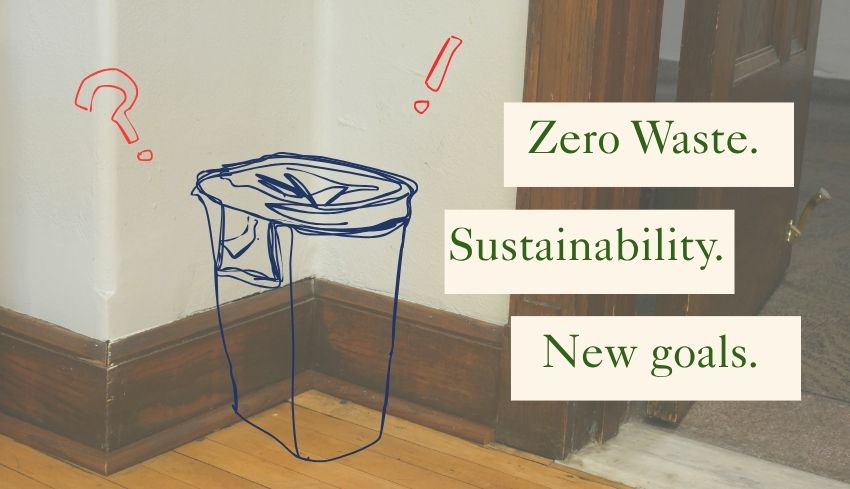
The Office of Sustainability (OoS) is introducing changes across campus regarding waste management starting fall 2026. A new initiative — aiming to consolidate waste collection — resulted in trash cans being removed from classrooms, study areas and other low-use areas. This comes as the first step in a series of strategic moves to help advance the Butler University Sustainability and Climate Action Plan (BUSCA).
In addition to removing trash cans from places where they are not often used, other changes brought about by the OoS include calculated placement of the cans andsignage featuring images of items allowed in each can, custom-made by building type.
The cans and waste bags are also now color-coded. Blue cans with clear waste bags are used for recycling, and black cans and bags are used for trash.
Tess Elliott, sophomore strategic communications major and member of environmentally-focused club EcoReps, agrees that there is a problem regarding trash on campus.
“[Solving this problem] starts with getting people to think more mindfully about what they’re buying and consuming, which [can] be difficult,” Elliott said.
A more behind-the-scenes switch is the composting of all discarded food scraps in A-Town Cafe and Midtown Provisions. The increase in composting across campus is a major stepping stone in transitioning to zero waste, meaning the university will “divert 90 percent of its waste from landfills and incinerators”.
Julie Lindeman, the university’s assistant director of operational sustainability, focuses on operational changes impacting campus sustainability. She has worked in higher education sustainability throughout her career and currently manages logistics of projects such as waste infrastructure, energy efficiency and the composting system. Expanding campus-wide composting is one of her major goals.
“One of the reasons why we have been resituating a lot of the cans across campus is because if we want to start collecting compost in the future, we need to make sure that we have compost, trash and recycling at each location,” Lindeman said.
Another significant change was the installation of intelligent sensors in the dumpsters across campus. These provide data points for the OoS to see how full the dumpsters are and when they are getting picked up, showing how much waste by weight is actually being produced on campus. The OoS is working toward a campus-wide ratio of 90% recycling waste and 10% trash.
Julia Angstmann, the executive director of the OoS, stated that the sensors have significantly helped to “streamline operations”.
“The first challenge we had was we couldn’t even measure our waste,” Angstmann said. “We were working a little bit in the blind.”
Since getting the sensors, the OoS concluded that there were operational issues with recycling and has worked closely with the company that owns many dorms on campus to correct these issues.
“We want students to believe and trust in the process, so we’ve been spending a lot of time making sure that process works,” Angstmann said.
The aforementioned trash to recycling ratios, along with other goals for campus sustainability, are outlined in the BUSCA. Butler has pledged to be “zero waste” by 2030, “net neutral” on carbon emissions by 2050, sustainably managing 70 of the 300 acres on campus and sustainable literacy — educating students, faculty and staff on sustainable practices — for all by 2040. These goals are assessed every five years to make sure they are on track to be met.
Elliott said campus sustainability is a very necessary issue.
“[Sustainability] is becoming more of a hot topic for people our age because we’re watching how climate change affects us in real time, [and] I think that that alone is a reason to become involved,” Elliott said. “Everybody should take a look into [sustainability] and keep exploring different ways to be sustainable, because there’s a lot of different little things you can do day to day.”
Lindeman noted that the best thing students, faculty and staff can do to support sustainability on campus is to understand how and what to recycle.
“If everyone can start looking at the signage and actually separating their waste correctly, that is one of the biggest steps somebody could take right now,” Lindeman said.
Educational materials regarding waste management include an online waste disposal guide, Ask.Butler forums and a Canvas course including sustainability training modules, as well as campus-wide announcements and email communications.
Angstmann corroborated Lindeman’s statement, saying she hopes students, faculty and staff read and understand the materials. Questions or suggestions can be directed to sustainability@butler.edu.
“We want people to understand, and we want to provide those resources as best we can,” Angstmann said. “Speak out, share what your hopes are for campus.”
Angstmann also acknowledged that environmental issues can sometimes feel “insurmountable”, but she encouraged people to not get discouraged.
“What you do matters,” Angstmann said.