
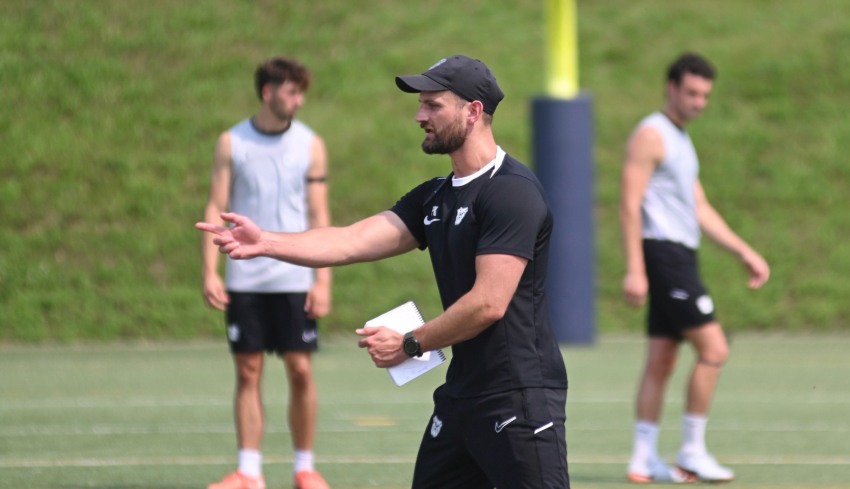
After men’s soccer head coach Ian Sarachan was hired, he wasted no time in bringing on an assistant who had expertise, experience and even national appearances.
With a professional career that spanned 12 years, five teams, three countries and five senior caps for the U.S. men’s national team, assistant coach Perry Kitchen provides a wealth of knowledge to a team still finding its identity.
Kitchen won the 2010 NCAA Championship with the Akron Zips in his only collegiate season, and was drafted third overall by D.C. United in the 2011 MLS SuperDraft a month later.
One of 11 players who signed a Generation Adidas contract for the year, Kitchen was only 18 years old when he was drafted.
He recalled the transition from facing opponents a few years older than him to having teammates almost twice his age being challenging, but the chance of playing professionally was worth it.
“My first year [in the MLS], I’m 18 [turning] 19 [years old and] I think our goalie was almost 40,” Kitchen said. “You’re playing with the best of the best within this nation, which is awesome, but it’s definitely an adjustment. It’s faster, it’s more athletic, it’s cleaner on the ball. Every player who wants to push themselves wants that [challenge] because you want to play against the best and compete with the best.”
Kitchen finished his rookie season as a finalist for the 2011 Rookie of the Year award, and was voted D.C. United’s Most Valuable Player two years later.
After his contract expired in 2015, the defensive midfielder went on to play in Scotland and Denmark for Heart of Midlothian and Randers FC, respectively. During his time overseas, he was voted team captain for Hearts just six months after joining the team.
Three years later, in 2018, he returned to the MLS with the LA Galaxy, playing on the same team as the famous Swedish striker Zlatan Ibrahimović.
Sophomore midfielder Max Klein believes that Kitchen’s time playing across the globe and with top players makes him a better coach, as he knows how to explain the game in the easiest way possible.
“It’s exceptional to work with someone with his degree of experience,” Klein said. “He’s just an outstanding player, and you can tell that his expertise comes from experience. All the advice that he gives you is not something that’s hard to grasp [or] weirdly tactical. Everything is like common sense, and because of his experience, he can transfer it to you in a manner that is easy to [process so] that you can easily implement it in your own game.”
Following a stint with the Columbus Crew, Kitchen hung up his cleats in 2022 when a back injury forced him to retire earlier than he liked. After briefly working in mortgage, he wanted to return to the pitch — but this time as a coach.
As he was looking to start coaching college teams, Sarachan was beginning his search for staff.
“The soccer world’s a small world,” Sarachan said. “One of my best friends played with Coach Kitchen in Los Angeles with the Galaxy, and got us connected initially back in November. He was looking to move into the college soccer world, and I was looking for an experienced guy to come on my staff. [It] kind of manifested naturally that way.”
Now, nine months into his role as assistant coach, Kitchen has embraced the new challenge coaching brings. While he boasts a wealth of experience as a player, he found that it did not prepare him for his role on the sidelines.
“Coaching’s tough, I will say,” Kitchen said. “As a player, you see [the game] from one side, and then as a coach, it’s a completely different side. I’m no expert by any means; just because you play at a high level doesn’t make you a great coach. Good experience as a player [helps the transition], but being a coach is tough.”
Kitchen also notes that coaching college soccer comes with its own intricacies. One skill he is still learning is how to balance personalities, especially as the players are entering a new chapter in life.
“You have to be able to manage humans,” Kitchen said. “They’re young guys, they have a lot on their plate with classes and stuff. It’s taught me how to communicate with guys differently. Some guys take to certain ways of teaching better than others, so you always have to be on your toes. It’s a hungry [and] competitive [group of] guys, and managing all that has certainly been a task, but [an] enjoyable [one].”
A former central defensive midfielder, he primarily works with defenders and defensive midfielders, but also coaches the team on set pieces, such as free kicks. Aside from coaching, he helps Sarachan with opposition reports, preparing the team for practices and individual player development alongside fellow assistant coach Guillermo Laguna.
For a coaching staff that is in its first season of working together, Kitchen provides another new insight into the game and the team. Sarachan noted that Kitchen’s comprehension of the game allows him to be a major contributor to the team.
“[The fact] that he does have perspective [allows him] to understand when to pick his spots in terms of getting involved with the guys, or when to have an opinion in the office,” Sarachan said. “Everything in this sport goes around. Wins and losses, these things come and go, but he understands that there’s a process and helping the guys understand that [has] been huge.”
Kitchen brings more to the table than just expertise on the game, as Klein explained he also provides an intellectual view.
“[He knows a lot about] how to use common sense while playing — taking the easy pass [and] not taking risks, but making smart decisions,” Klein said. “Because he’s played so long, he’s been through thousands of reps in every possible situation, and because of [that], his decision-making is always on point. That’s what he can help us [with] the most.”
Off the pitch, Kitchen is dubbed by Sarachan as “a real dude” — someone who is honest, hard-working and straightforward. In the locker room, Klein said that Kitchen has told some of the funniest jokes the team has heard.
While acknowledging that the assistant coach is not the most commanding voice in the room, Klein noted that every time he says something, the whole team listens.
“He isn’t super loud, but every time that he communicates, every time he says something, it’s something of value,” Klein said. “[It’s either] something interpersonal that’s funny or entertaining, or it’s something that improves you as a player or person. He’s not the type of person to yap a lot, but every time he contributes something, it is of importance.”
Only three players have consistently started for the Dawgs, and it is clear the team is still working on discovering its identity and what brand of soccer it wants to play. However, Kitchen already has high hopes for a team he believes is hungry for success.
He dreams of returning the Bulldogs back to their glory days, which include a national ranking, conference championships and even NCAA Tournament appearances.
While Kitchen acknowledged there is a long road to getting there, he has no doubts the team can achieve it.
“We want to get Butler back to a place that they were when I was [playing at Akron],” Kitchen said. “They were a top-10 program [with] one of the best defenses in the country. Getting them back there, it’s not easy. It doesn’t just happen [overnight]. It’s step by step, game by game. [I] hope to return them to that [level of success] with the coaching staff and Ian.”
As the Bulldogs work through growing pains, Kitchen aims to be a reliable and expert presence for the players as they go through their college career.
“I want [the players] to feel like I was somebody who was in their corner, was able to push them, help get them better and just use my experience to get them to the next level if that’s what they want. And I think they do [want that]. They’re a hungry group, [and I] just [want to] help them in any way they need.”