
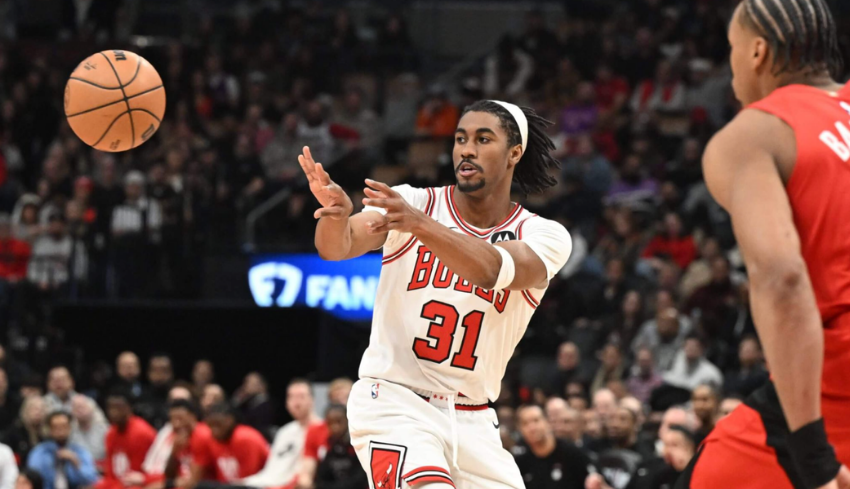
In late March, Chicago Bulls guard Jaden Ivey quickly became one of the most polarizing names in the NBA this season. After the 24-year-old posted a series of lengthy livestreams on Instagram that included anti-LGBTQ statements and comments critical of the NBA’s celebration of Pride Month, the Bulls waived Ivey, citing “conduct detrimental to the team.”
The move came quickly and followed earlier livestreams in which he invoked religious beliefs and critiqued league culture. Bulls head coach Billy Donovan emphasized the organization’s commitment to professionalism, calling the behavior incompatible with team values.
“Everybody comes with their own personal experiences, but one [thing ] is we’ve got to all be professional,” Donovan said. “I think there’s got to be a high level of respect for one another, and we’ve got to help each other and then be accountable to those standards.”
Ivey was acquired from the Detroit Pistons in a three-team trade on Feb. 3, but only appeared in four games for Chicago before being sidelined with a knee injury.
The former Purdue standout has since defended his comments and questioned whether his faith played a role in the Bulls’ decision to waive him.
Reports following Ivey’s release suggested the controversy may have extended beyond the livestreams themselves. According to multiple reports, Ivey developed a reputation among teammates and staff for frequently preaching in team settings and initiating religious conversations that made some around the Pistons uncomfortable.
Sources indicated that frustration inside the locker room had been building before the slew of social media posts, and that the public controversy ultimately accelerated a decision Detroit was already considering.
While the Bulls never publicly detailed those internal concerns, reports suggest the situation had evolved into more than a single public outburst.
The circumstances surrounding Ivey’s spiral raise a broader question as fans scrutinize the league’s disciplinary playbook. Why do some controversies result in quick, career-altering consequences, while other incidents involving more familiar faces around the league are swept under the rug?
In September 2022, Minnesota Timberwolves star guard Anthony Edwards posted a video on Instagram of a group of men on a sidewalk. The Timberwolves star could be heard making a profane comment about what he assumed to be their sexual orientation.
Both the team and Edwards issued statements apologizing for the incident, and Edwards was met with a $40,000 fine from the NBA.
While Edwards’ punishment came in the form of a fine, other NBA controversies have involved far more serious allegations, and yet have never resulted in removal from the league.
In June 2022, Charlotte Hornets forward Miles Bridges was arrested in Los Angeles and later charged with felony domestic violence following an alleged assault involving the mother of his children. Photos were shared publicly by the victim and showed visible injuries, quickly turning the case into one of the league’s most analyzed off-court incidents in recent years. Bridges ultimately pleaded no contest to the charge and was placed on probation as part of a plea agreement.
The NBA suspended Bridges for 30 games in April 2023, though he had already missed the entire 2022-23 season while the case unfolded. Because of that missed time, he served only a portion of the suspension before returning to the Hornets in November 2023.
For some fans, the contrast between Bridges’ return and Ivey’s abrupt departure raises questions about how the league balances discipline with competitive value.
Milwaukee Bucks guard Kevin Porter Jr. recently had a case following a similar trajectory. In September 2023, the then-Houston Rockets guard was arrested in New York and charged with assault and strangulation following an alleged domestic incident involving his girlfriend. Porter Jr. was traded and waived shortly afterward, playing in Greece during the 2023-24 season before returning to the NBA for the 2024-25 season. Porter Jr. was handed just a four-game suspension from the NBA after legal charges were reduced as part of a plea agreement.
Henry Sterbenc, a first-year health sciences major, said the disparity is hard to ignore.
“I think both are worse than what Ivey did,” Sterbenc said, referring to the cases involving both Bridges and Porter Jr. “But the public didn’t make as big of a deal as [it did] about Ivey’s comments.”
Though Porter Jr. did not immediately return to the league, he has since continued to play and earn in the NBA, most recently signing a two-year, $11 million contract in July 2025. Porter Jr. averaged close to 18 points per game this season before being put on the shelf for the remainder of the season in March with a knee injury.
To Sterbenc, the league’s response across these cases appears heavily shaped by public pressure.
“[Punishments differ due to] public outrage and backlash,” Sterbenc said. “If the media is criticizing the NBA, they are going to have to force their hand into making more rational decisions.”
Other observers, like Brian Beck, a first-year finance and risk management major, believe in a simpler explanation: economics.
“At the end of the day, the NBA is an entertainment business,” Beck said. “It’s a profit equation.”
Beck pointed to Edwards as the easiest example.
“Edwards draws huge attention,” Beck said. “Fans would be absolutely livid if he were let go.”
Edwards is undoubtedly one of the league’s fast-rising stars in recent memory, helping lead Minnesota to deep playoff runs while building a reputation as one of the NBA’s most marketable personalities. While the league fined Edwards for his comments in 2022, he was not suspended.
That contrast highlights what some, like sophomore marketing major Alec Johnson, see as a pecking order within the league.
“I think you see more star players get away with stuff in general,” Johnson said. “There’s kind of a hierarchy within the league. The more revenue [and] ticket sales you bring in, the more stuff you can get away with.”
Johnson added that while players should be held accountable for their actions, the question of second chances is complicated.
“I always believe in second chances,” Johnson said. “But at some point, you become too much of a risk. [As the NBA], you don’t really want to jeopardize [your brand].”
That tension between accountability and opportunity sits at the heart of the debate surrounding Ivey, Edwards, Bridges and Porter Jr.
Each case involved diverse circumstances, and each produced a different response from teams and the league. Ivey was waived shortly after his livestream comments. Edwards received a fine. Bridges served a suspension before returning to play, while Porter Jr. worked his way back to the league after time overseas.
When looked at side-by-side, these cases illustrate a difficult balance the NBA must navigate between maintaining its public image and protecting the competitive value of its players.
Some have also pointed to the possibility that the episode reflects a broader conversation to be had about mental health in professional sports. In the days surrounding his release, Ivey’s livestreams became increasingly eerie, with the 24-year-old even saying his wife was no longer speaking to him.
The situation draws comparisons to former Hornets center Kai Jones, whose erratic livestreams and posts in 2023 raised questions about his well-being before he was eventually waived by the team.
Specifically, why Ivey has had this episode remains in question. While there has been no official indication that Ivey is experiencing any sort of crisis, the episode highlights how public outbursts from athletes can blur the line between disorderly conduct and potential mental health struggles.
Whether those decisions show signs of hypocrisy, business reality or simply the complexity of policing a professional sports league remains a matter of debate.
But as fans continue to scrutinize how the league handles misconduct, the question remains: who gets a second chance, and why?