
The Hub for Black Affairs and Community Engagement (HUB) continued its Black Intellectual Series (BIS) for the sixth year since its start in 2020. This year’s theme discusses Black erasure and the importance of raising awareness about its impact on Black communities.
Through a series of lectures, the HUB invites Black faculty, students and community figures to educate the Butler community on the history of Black erasure and the efforts being made to combat it. This includes the work of organizations such as the Divine Nine (D9), a collective of historically Black fraternities and sororities.
Felicia Williams, faculty director of HUB, explained the purpose behind the BIS and why the topic of erasure matters, especially now.
“The [BIS] is really just our attempt to make sure that we are amplifying and elevating things that disproportionately impact the Black community,” Williams said. “Because of various things that have happened over the last few years, we thought erasure was a huge one, with the removal of different statues or the renaming of entities that relate to periods in the past that people don’t necessarily want to talk about or deal with.”
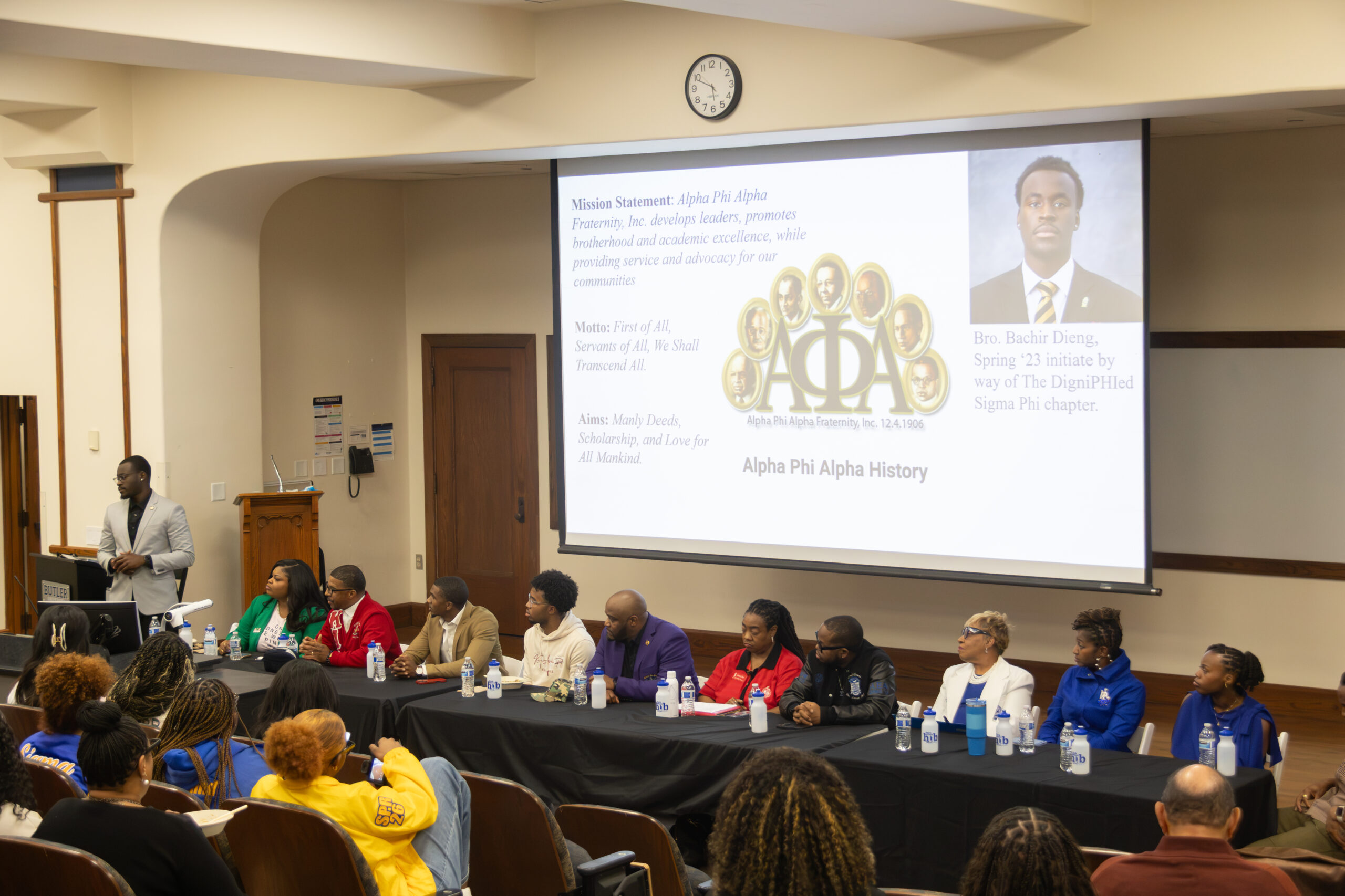
The series’ second lecture, titled “And We Still Rise: How the D9 Organizations Counter Erasure on College Campuses,” took place on Nov. 4. The lecture brought together representatives from D9 organizations to discuss the steps their chapters are taking to preserve Black history, challenge erasure and strengthen their presence on college campuses.
Victory Sampson, a Butler alum and a member of Iota Phi Theta Fraternity, began the panel by defining erasure.
“I would classify Black erasure as any form of not just systemic-level policy change,” Sampson said. “Also on an interpersonal level, action done specifically to mitigate the voices, the social or monetary capital, and just the general impact of Black people and organizations.
Throughout the lecture, panelists emphasized the importance that community service has in challenging erasure.
Nichelle Hayes, a member of Delta Sigma Theta Sorority, further elaborated on how she feels D9 community service makes the organizations stand out during the panel.
“What you have to do is stand fast in the work that you’re trying to do for us,” Hayes said. “We stand on our mission, and we’re going to continue to do the work, going out into the community. It’s just about service. Sometimes it’s a matter of wordsmithing, and then sometimes you don’t always want to shout out necessarily what you’re doing. You just quietly do the work, and you continue to band together.”
Another main point mentioned in the lecture was knowing the history of these organizations and remembering the hardship the founders faced.
Norma Dartis, a member of the Zeta Phi Beta Sorority, emphasized that preserving this history is especially important when organizations and communities face attempts at erasure.
“I think it’s important to remember that if somebody’s trying to erase you, you must have something pretty valuable that they feel they need to suppress,” Dartis said. “It’s very important for all of our organizations to be very steeped in our history, and to be able to pass that down. If we don’t do that, then it will soon be forgotten, and it will go by the wayside.”
This discussion also highlighted Butler’s own connection to the D9 through Sigma Gamma Rho Sorority. The sorority is one of the nine historically Black-letter organizations and was founded at Butler in 1922 by seven Black women educators. Sigma Gamma Rho is the only D9 sorority that was founded at a predominantly white institution.
Raeghan Jefferson, a 2025 Butler graduate and member of Sigma Gamma Rho, explained why understanding and sharing the sorority’s history is important to preserving the legacy of its founders.
“My founders had to walk past the leader of the KKK’s house every single day to obtain their education,” Jefferson said. “I think the erasure comes from us not telling the whole story. I think it’s super important to be able to recite and tell people what you’re telling your sister, so they can understand and grasp the gravity of what it’s like to be their living legacy.”
The lecture also mentioned ways D9 organizations, especially undergraduates, can maintain leadership and traditions on college campuses.
Three main points were mentioned. First, there needs to be more cross-generational collaboration. This means older generations need to talk with younger generations and vice versa. Panelists also mentioned avoiding putting any of the organizations at risk and upholding their reputation. They also discussed being intentional about the impact being made.
Ilisha Dowell, a member of the Alpha Kappa Alpha Sorority, shared that one way D9 can avoid putting their organizations at risk is to avoid hazing.
“We can do the smart thing and avoid hazing because this is the reality. Hazing is a major risk to our existence,” Dowel said. “What happens to our organization? What does that do for us? Stop hazing. Don’t put your chapter at risk. That’s how you stick around.”
Panelists highlighted that countering erasure requires more than just remembering history. It means continuing to live out the values, traditions and missions that allowed these organizations to exist in the first place.
Noell Allen, a member of Zeta Phi Beta Sorority, emphasized the importance of being true to oneself.
“No one can tell you who you are,” Allen said. “A policy cannot define you. The funding cannot define you. So exist.”
More information on the HUB events can be found on their Instagram page.