
This article was updated for clarity and to include a statement from Ying Chen, Vice President and Conductor of Shen Yun Performing Arts, on March 9.
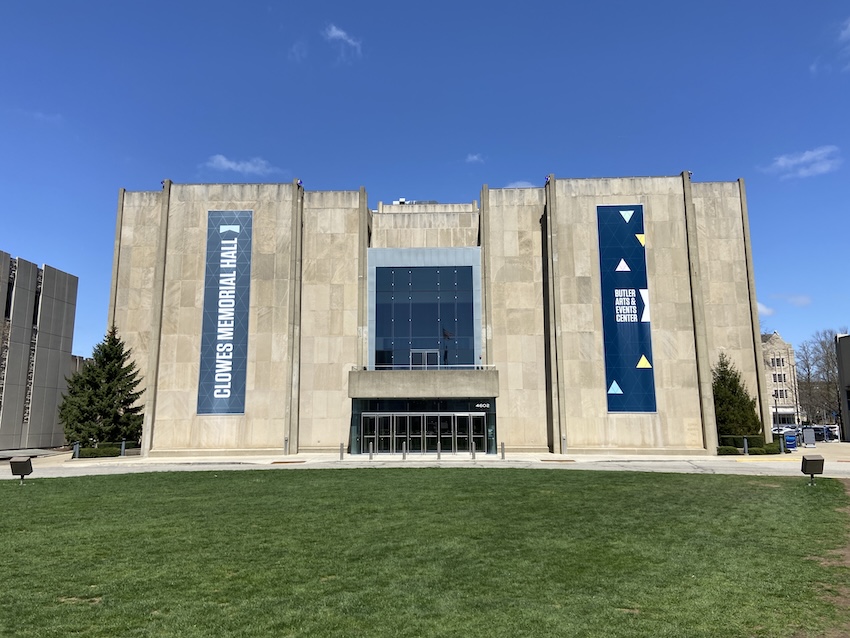
On Feb. 21 and Feb. 22, a dance group known as Shen Yun Performing Arts performed at Clowes Memorial Hall.
With 18 different pieces, Shen Yun promises to tell the story of a “China before communism” through the art of traditional Chinese dance and music. Audiences are mesmerized each year by the demonstration of artistry and power.
Jacqueline Harbor, an Indianapolis resident, was drawn by the immense talent the performers and musicians demonstrated.
“The athleticism, performance and the music is awesome,” Harbor said. “I love the effect where they jump in and out of the screen. That special effect is really fun.”
Other returning attendees felt the intricate storyline meshed with the beauty of the performance created an entrancing effect on its viewers.
David Gerichs, a resident of Carmel, explained his thoughts on this years’ performance.
“I’ve been one time before,” Gerichs said. “It’s very stunning and pretty to watch. I enjoyed the story more this time than I did the first [time I saw it].”
What most attendees do not realize, however, is that behind the elegant costumes and imaginative dances lie troubling allegations of abuse and exploitation within the company. Two different lawsuits and investigations by major news outlets extensively document the ongoing issue.
A history of alleged exploitation
In an investigative piece, the New York Times interviewed 25 former Shen Yun performers and instructors who spoke about their experiences within the group. Many said they endured untreated injuries from the company and were discouraged from seeking medical care by their instructors.
Shen Yun is run by the Falun Gong religious movement, a spiritual discipline founded in the early ‘90s by Li Hongzhi. The movement has been banned and outlawed in China, and the group claims in its print program that it has endured harassment and persecution from a country that has “tried to destroy these traditions.” While the main tenets of Falun Gong are truthfulness, compassion and forbearance, the group also discourages the use of medicine in its teachings.
The Times interviewed Kate Huang, a dancer who dropped out of school at age 11 to join Fei Tian Academy of the Arts, the compound where Shen Yun dancers are trained.
Huang described the intense pressure to ignore medical issues in order to prove herself as faithful to the Falun Gong practice.
“If I ask for the hospital, I will be labeled as not a fervent believer,” Huang said in the interview. “I didn’t want to stick out or become a target of everyone.”
In addition to its denial of medical treatment, Falun Gong encourages its followers to spread the word of Shen Yun to save the world from an impending apocalypse.
Using the guise of dance, performers are encouraged to work 15-hour days, often with little to no pay. In addition, many of the performers are children of Falun Gong practitioners who say they were coerced into the dance group. According to a lawsuit filed by two former dancers, child workers were often exploited and made no more than $500 a month for their labor.
Does Shen Yun violate Butler policies?
According to the university’s Rules of Conduct, Butler students are prohibited from any
“physical, mental, or verbal abuse of any person or any conduct that threatens or endangers the health or safety of any such person.”
Shen Yun, however, was permitted to perform on Butler’s campus, despite a well-documented history of abuse and exploitation allegations.
The expectation of good conduct does not solely apply to Butler students — the university holds guests of students responsible for their conduct as well. The university’s statement on the standard of conduct emphasizes that “because the actions of guests also affect members of the Butler community, students assume responsibility for those they host.”
However, it seems that Butler’s guests, such as those invited to perform at the Butler Arts and Events Center, are exempt from this policy. Performances of Shen Yun have been documented at Clowes as early as 2014, and public knowledge of investigations into the show’s allegations of exploitative practices began surfacing in 2024.
Senior biochemistry major Kate Thuma attended the performance but was unaware of the abuse allegations until researching the group following the event. She emphasized the importance of thorough decision-making for selecting shows to present at Butler.
“If there are abuse allegations, it might be wise to steer clear of hosting them at our campus,” Thuma said. “Thoughts should [definitely] be put into that.”
Butler Arts and Events Center did not respond for comments by the time of publication.
In an email statement sent to The Butler Collegian on March 6, Ying Chen, vice president and conductor of Shen Yun Performing Arts, responded to these allegations.
“Behind Shen Yun are real artists who have devoted years of effort, passion and commitment to building this company despite enormous challenges,” Chen stated. “Over the past two decades, more than a thousand performers have appeared with the company, yet recent coverage has focused primarily on criticism from a small number of former participants while overlooking — and disheartening — the many artists whose experiences tell a very different story. Indeed, more than 1,500 current and former Shen Yun performers and their immediate family members have signed a public statement describing recent allegations as ‘gross distortions and false narratives about our work, our faith and our way of life’. [This] article raises serious accusations, yet it does not appear to include independent verification or perspectives from the great majority of performers whose experiences contradict such claims. From a single troupe in 2006, Shen Yun has grown to eight touring companies performing simultaneously around the world—growth that would not have been possible if the environment described in these allegations reflected the reality experienced by our artists.
The Butler Arts and Events Center has hosted Shen Yun for many years because audiences consistently respond positively to our performances and artistic mission, and we have always valued the opportunity to share our classical heritage with the Butler community. Readers interested in concerns surrounding recent New York Times coverage may consult the analysis “12 Things to Know About The New York Times’ ‘Investigation’ of Shen Yun and Falun Gong”. Students and readers deserve a fuller picture—one that includes the voices of the many artists whose resilience and commitment to preserving a cherished cultural heritage continue to shape Shen Yun today.”
Intense marketing
In 2023, Shen Yun amassed a staggering $266 million in revenue from ticket sales. How does a show with such an intense and dark collection of allegations maintain its popularity?
Falun Gong followers are encouraged to help sell tickets to Shen Yun with the understanding that the performance will save viewers from a coming apocalypse by educating them on its spiritual practices. In addition to this method of local engagement, Li has been accused of encouraging his followers to give up their life savings to support his luxurious lifestyle.
One follower, who worked unpaid for years as a top aide to Li gave the organization her life savings before dying of late-stage kidney cancer. The cancer was left untreated, as Falun Gong encourages meditation as a way to rid the body of “bad karma” that causes illness.
The pull of a beautiful performance with widespread marketing may be irresistible to some. When knowledge surfaces of shocking allegations, however, the responsibility of a university to investigate the shows that visit its campus becomes increasingly valuable. Whether Shen Yun will return to campus for another year of performance is yet to be seen.