
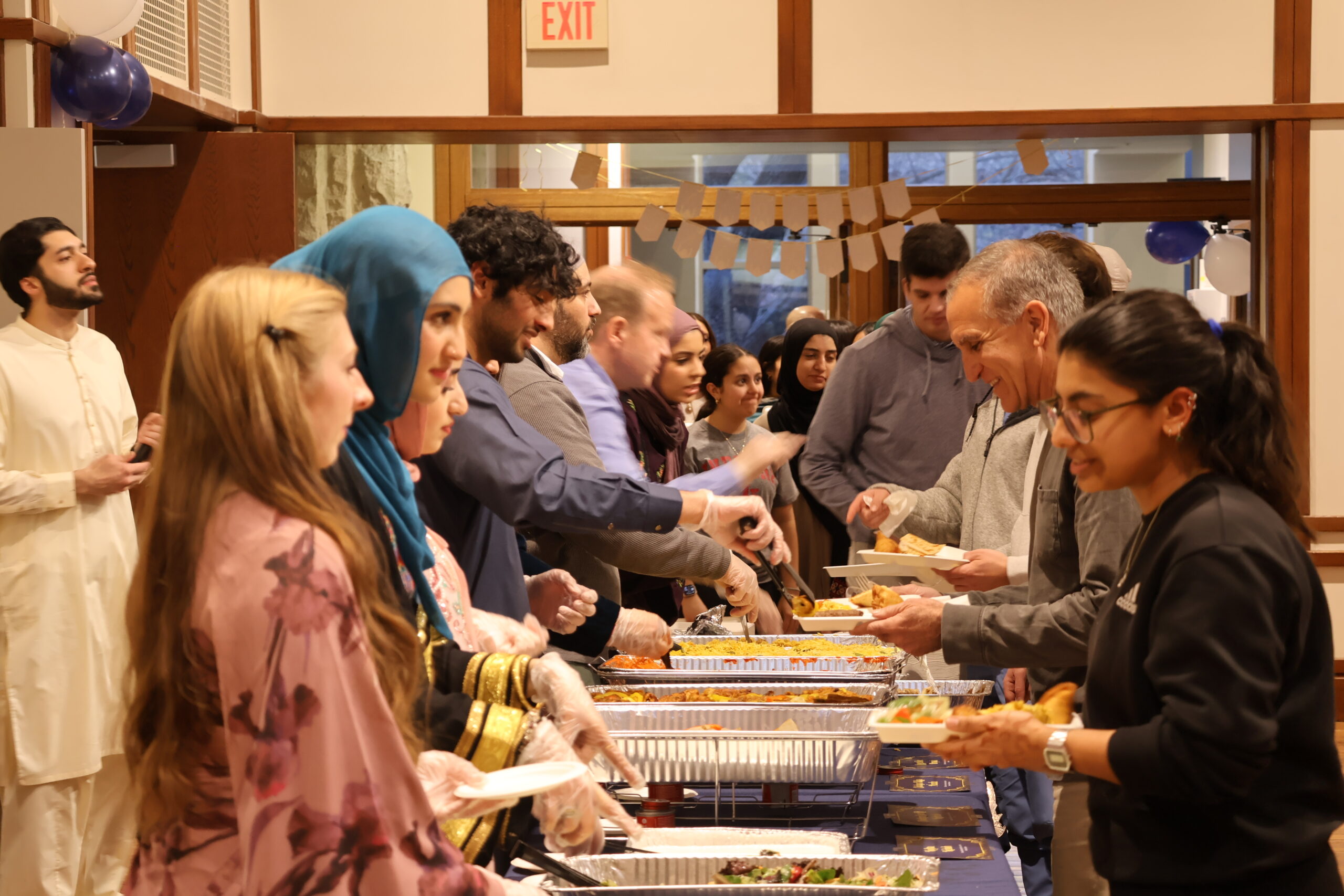
The Muslim Student Association (MSA) hosted its fifth annual iftar on Feb. 25 in the Reilly Room, where students and community members joined together to break their fast. The evening began with a presentation on what Ramadan represents for Muslims and its traditions, and then attendees joined for prayer and a traditional meal of different Middle Eastern and South Asian foods.
In Islam, the holy month of Ramadan marks the ninth month in the lunar calendar, when the Quran was revealed to the Prophet Muhammad. Throughout the month, Muslims partake in fasting from sunrise to sunset, and in the evenings, they join together for a fast-breaking meal, iftar. Ramadan is a time when Muslims connect with their community and faith through discipline and tradition.
Sahar Atmar, a junior biology and Spanish double major and president of MSA, expressed how Ramadan has helped her grow.
“A lot of people think [that] when you take something so integral as your food and water away, you’re forced to put everything else into perspective,” Atmar said. “It teaches you dedication and discipline. If you can dedicate yourself to doing something that’s so difficult, like starving yourself all day, you can definitely dedicate yourself to being a better person, using your tongue more kindly, not speaking badly to people and making sure that you’re being ethical in every act that you do.”
This year marked Atmar’s third iftar on campus as a part of MSA, and she has valued this event and all that it brings to campus. She has loved educating the community about the important traditions of her religion while providing a safe space for Muslims at Butler.
Hassan Hashmi, a sophomore healthcare business major and MSA member, discussed why he finds this event important, noting that learning about other cultures is invaluable.
“When you open your mind, and you learn about what different faiths have to say, or what different cultures are about from their own standards and [you are not] projecting your standards onto them, I think you become a much more well-rounded and intelligent individual,” Hashmi said. “It makes processes, like navigating life, a lot easier.”
Atmar reiterated this idea, finding college a crucial time for cultural education, as growing up as a minority student can be very isolating.
“At the age of 10, it felt like a really big burden to have to be the one to explain all of Islam to somebody,” Atmar said. “I wish that an adult were able to convey those things, because … When you’re 10 years old, you’re not an expert in your faith. I don’t think anyone is. I don’t think we should expect that from people. I think college is a big time that I saw and sought out opportunities to not only learn about my faith, but learn about all these other faiths.”
MSA aimed to educate students about their traditions, hoping to bridge the gap in cultural knowledge on campus.
Sisters Lily Tomlinson, a sophomore biology major, and Madi Tomlinson, a senior chemistry and Spanish double major, attended the iftar after passing the club’s tabling earlier in the month. They appreciated this chance to learn more about cultures that they have learned little about in school.
“You’ll never fully understand all of these cultures around the world unless you get to experience a little part of it,” Lily said. “I feel like it’s really important, especially with what’s going on today, to go out and take the time as college students [to experience other cultures] when the opportunity comes.”
They also acknowledged the accepting environment of the event, as they strived to include students of all backgrounds.
“We didn’t fast for the [iftar], but I still felt really invited,” Madi said. “It was really cool to see how welcoming [MSA was], allowing us to experience this [tradition] that is so special and important to them.”
MSA is excited to continue its tradition of holding an iftar in upcoming years, taking advantage of any opportunities to share its culture with students and grow its community.
“There’s a different feeling in the air when it’s Ramadan,” Atmar said. “There’s a sense of community [knowing] I’m gonna see my people all the time. I’m gonna be in prayer with people all the time; we’re going to be in conjunction, trying to better ourselves and be kinder to one another, and just learning more about ourselves in our community. During this time, we are so much more in sync with one another.”