
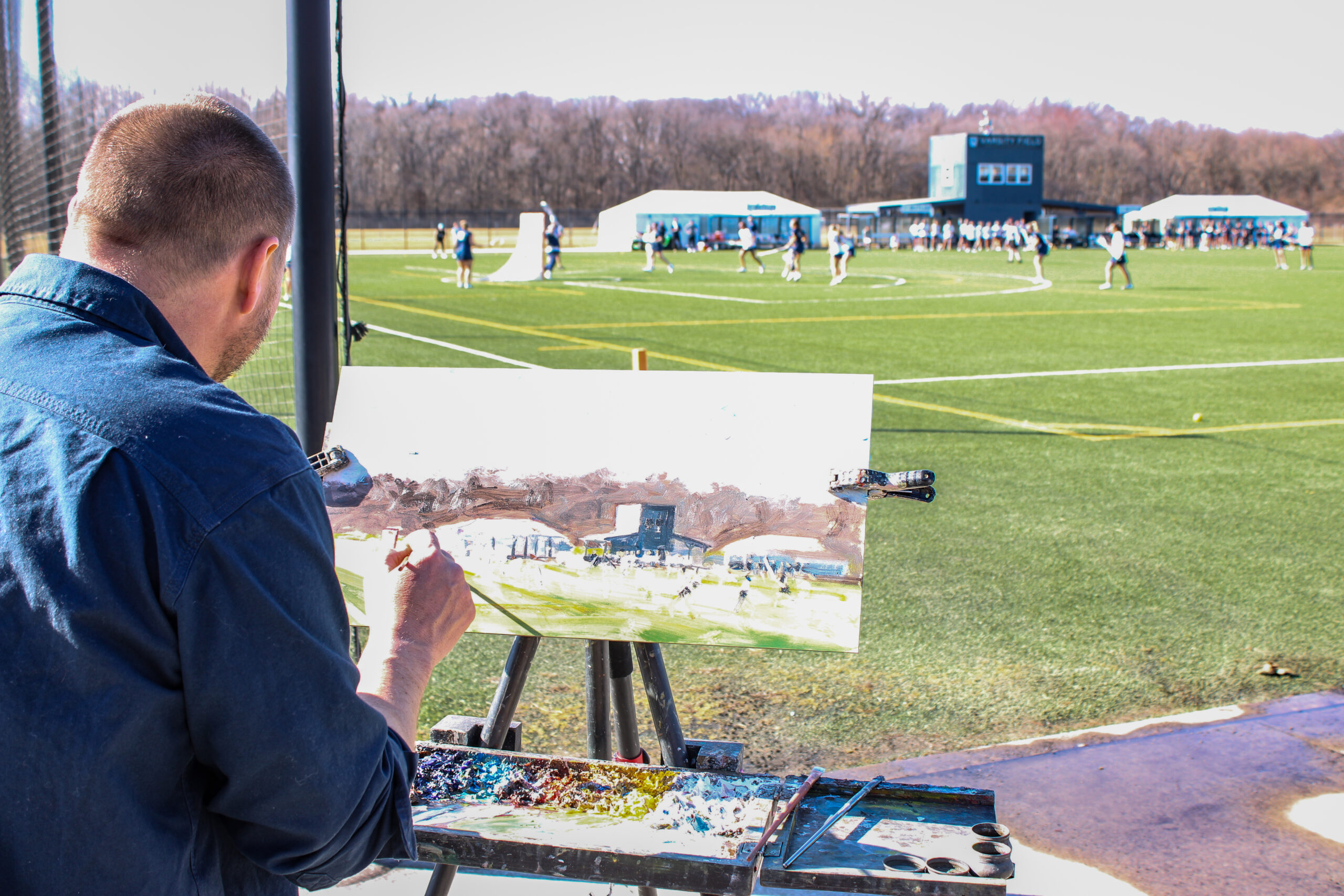
Frequent visitors to Hinkle Fieldhouse over the past year have likely noticed a new, recurring character meticulously painting a portrait amidst the chaos in the upper deck of the Old Barn.
Justin Vining, the official painter of Butler Athletics, has been creating portraits around campus for years since opening his local Indianapolis studio in 2011 — even constructing a 20-by-40-foot mural in 2017 that was displayed inside Clowes Memorial Hall before its renovation.
However, it was not until Vining was introduced to deputy athletic director Mike Freeman and former director of marketing Heston Hybarger that the door opened for him to paint live games at Butler. The introduction was made by Michael Kaltenmark, Indianapolis Motor Speedway’s (IMS) head of marketing and former Blue handler, and the two sides have exponentially grown their relationship since.
On Nov. 22, 2024, Vining created his first live portrait inside Hinkle Fieldhouse for a non-conference match against Merrimack.
After a few more successful trips to Hinkle during the 2024-25 season, Freeman and the athletic department met with Vining to create various paintings of architecture and buildings around campus, which will eventually be put on display at a free art show in Hinkle, set for April 9.
Since then, Vining has painted upwards of 20 live sporting events across campus, most recently at the Feb. 21 men’s basketball senior day against Xavier.
“Hinkle has hosted almost everything, so we figured [we] might as well try something else,” Freeman said. “We started in the middle of August with a goal of having 40 to 50 paintings by the end of the spring semester. He’s been working really hard and making some beautiful paintings, and people will have the chance to see them firsthand.”
It was a long time coming for Vining to find a place to be showcased and embraced in such a unique way.
“I don’t think I could have ever imagined the direction my career has gone,” Vining said. “It’s pretty wild, to be honest. I started painting at IMS nine or 10 years ago, and right around that same time period, I painted my first Indiana Fever game for Tamika Catchings’ jersey retirement. Then, I did a little bit more [before] I painted my first game at Hinkle.”
Being a career painter was not something Vining originally had in store for himself, though. Graduating from Purdue University with a Bachelor of Arts in 2004, Vining was an elementary art teacher for three years before attending law school at Valparaiso University and working as a clerk at Douglas, Koeppen & Krsak until 2010.
“I’m a farm kid,” Vining said. “I always enjoyed art, but never thought I was really that good. I started selling paintings on the side in law school, and that was really what got the ball rolling towards this current trajectory.”
Standing today as a fixture of Butler basketball games and a familiar face painting various elements of campus, it all started with the athletic department’s desire to stand out with its gameday atmosphere.
That desire has paid dividends, with athletics now having one of the most unique forms of deliverable gameday content creation in the country, and Vining being the elegant bridge of sport and art.
“We all think Hinkle, the Sellick Bowl and all of our facilities are beautiful places to watch games,” Freeman said. “Why not have somebody create a beautiful picture of that day and moment? Every game has a life of its own. We’re going to make shots, we’re going to miss shots, but the other things that happen around a stadium are vital to people wanting to come back. [When] you get to Hinkle, you might see the mascot, interact with other fans, see the students jumping up and down, but something like this goes beyond traditional sport.”
The artistic element of Vining’s live portraits is no small feat, either.
Adjunct instructor of art Ellery Diaz knows it takes a “really skilled person” to complete a portrait during these live events.
“You’re trying to capture a moment that is ephemeral,” Diaz said. “A lot of his work is really quick movements without super harsh signs. It feels a little blurred on purpose, so it feels like it’s in motion, [which] works well for an athletic game.”
When Vining captures these live moments, he ensures that he emphasizes what makes that venue special, whether it is the seven big windows overlooking Hinkle, the IMS pylon or even the Varsity Field press box.
That attention to detail is what has pushed Vining to where he stands today in the Indy art scene.
While his popularity has steadily grown since opening his own studio, the farm-raised kid was thrust in front of his largest audience yet when making his first of several cameos in 2020 on HGTV’s “Good Bones”. The Indianapolis-based reality renovation show drew an average of over 700,000 viewers during its lifespan.
Across its eight seasons, Vining made around 15 appearances, curating murals, teaching art lessons and working on various artistic projects for the renovations.
“In some ways, [“Good Bones”] had a pretty significant impact,” Vining said. “Putting myself and my artwork in a position to be seen by a national audience, there was definitely an impact. Maybe not as [much as] people would think, but I sold quite a bit of artwork because of the show, even though I was just a tiny little portion.”
As Vining’s popularity grew and he continued to paint more, his appreciation for his craft continued to blossom as well.
“If painting wasn’t my job, I’d probably never find time to do it,” Vining said. “The last time I had a real job, I thought I’d be able to paint on the side, but it just wasn’t possible. As a painter, I’m able [to] add a lot of beauty to our world.”
Always being the man to capture the moment — for athletes and fans across several different mediums — his art has since become a way to capture several moments and milestones for himself as well.
“The longer I do this, the more meaning I find in doing it,” Vining said. “I don’t know if it’s as I age, [but] I just become more nostalgic. To do what I do daily, adding small parts of beauty to the world, I feel lucky. My work tells my life story. ”