
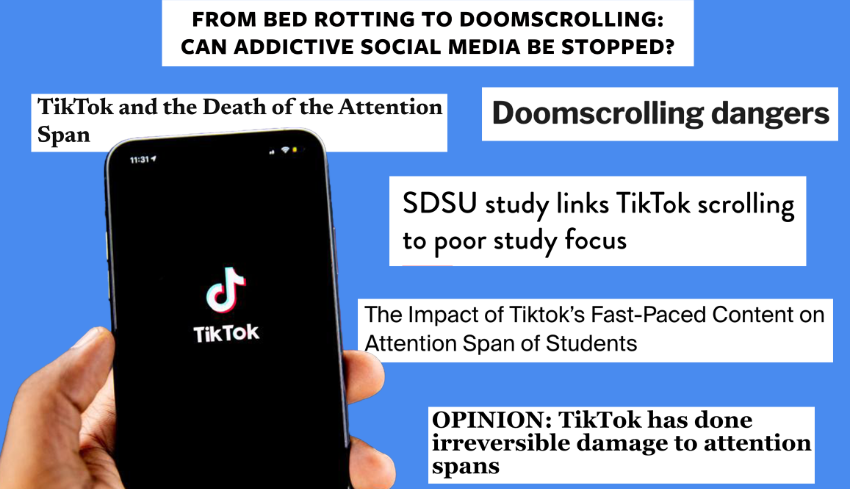
I’ll be the first to admit, my attention has gotten progressively worse ever since I got social media. I’m not proud of it.
Doomscrolling is terribly addicting. I can barely get through long-form content like YouTube or Netflix anymore without reaching for my phone every five minutes. Even when I want to focus on what I’m watching, I find myself scrolling instead. I honestly hate it.
I’ve noticed I’m not alone in this problem. It seems to be a common issue among Gen Z, and I’m blaming platforms like TikTok and Instagram for this
Annie Park, a professor at the College of Communication, said social media changed the way we direct our attention.
“I think it makes us more accustomed to constant stimulation and also endless choices,” Park said. “There’s always something next, and that really affects our ability to concentrate on anything because we’re waiting for the next thing.”
I believe this crave for constant stimulation is affecting our academic performance. Especially our ability to stay focused in class and retain information.
Platforms like TikTok constantly feed us new content, encouraging us to go from one video to the next. When we’re always consuming something new, sitting still and focusing on one task for a long period of time can be extremely difficult.
It would make sense as to why it’s hard for us to sit through class without checking our phones. Especially if the lesson isn’t something you’re interested in, your phone gives you an escape from that boredom.
Think about it. How many times have you glanced at your phone during class and missed important information? Multiple times, I’m sure.
That constant stimulation can also affect the way we retain information. When you’re scrolling through multiple videos in a short amount of time, your brain isn’t actually processing any of the information.
Max Haley, a junior sports media and journalism double major, shared his thoughts on doomscrolling and its effects on our memory.
“[If] you want a real test for how bad doom scrolling is, ask someone to go and scroll on their phone, and then ask them to remember the last three reels that they scrolled past,” Haley said. “Bet you 95% of people won’t even remember what the last one was.”
I could not tell you the amount of times I’ve sat through a lesson and forgotten what a teacher said even though I was paying attention. The information goes in one ear and out the other.
The content we consume also contributes to our ability to think critically. Our brains are moving so fast that when we actually sit with an assignment that requires sustained attention and long thoughtful answers, it’s hard. That’s why some people will resort to AI platforms like ChatGPT because it gives them quick answers.
Are our attention spans doomed? Is it possible for us to get our attention spans back?
I believe the first step is to become aware of how the constant short-form consumption is affecting your ability to focus. Once you become aware, that’s when it’s your choice on what action can be done to fix it.
Music education major Sophia Harris, doesn’t use social media at all and recommends setting aside any distractions while studying.
“I think when I schedule things, I’m going to put away all these distractions for half an hour and just work on something,” Harris said. “That’s when I get things done, and when my attention span is at its best.”
In our case, the distractions are our phones. When our phones are off and away from us, it’s less tempting for us to scroll and actually focus on the task in front of us.
Michael Aronson, a lecturer of journalism and creative media, said giving our attention to one thing can improve our attention spans.
“I think that slowing down, picking one thing, and just getting into the practice of focusing on that one thing for a few minutes a day develops the ability to focus,” Aronson said. “Don’t be like, ‘Oh I have to make it through a novel in the day.’ No, pick one simple thing. Keep it small, keep it manageable and keep it realistic.”
Another good solution to improving our focus is utilizing the screen time feature in our phones. The small step can help rebuild your tolerance for slow, sustained tasks.
Haley said setting time limits on his apps has helped him be more productive.
“I realized the effect that [scrolling] was having on my days and my productivity, and so I use time limits now for apps to be conscious of how much I am doom scrolling,” Haley said. “I do a bit each day, but I limit it and think before I go on an app.”
Our attention spans will not come back overnight. And I don’t believe we need to stop watching short form videos altogether.
Challenge yourself to sit through an hour-long movie. Put that time limit on your apps. Just start small, and realize that you have control over your attention span.
I promise you, TikTok can wait.