
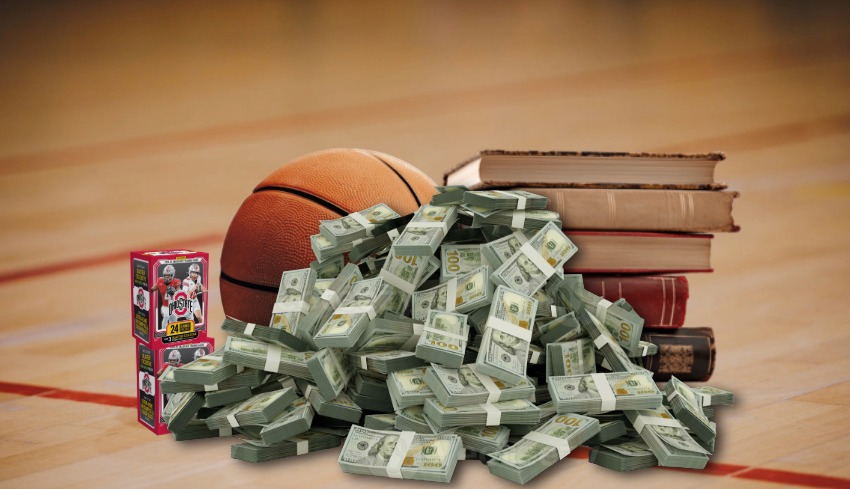
Overtime, or “OT,” is an opinion column series where the Collegian takes national sports headlines or polarizing topics and gives them a Butler-centric angle.
CALEB MCLAUGHLIN | STAFF REPORTER | cpmclaughlin@butler.edu
Yes, NIL is ruining college sports.
College sports have changed significantly over the last half-decade. Name, image, and likeness (NIL) rules were introduced to the collegiate level for a sole purpose of allowing college athletes to promote, and make money off their personal brands.
With NIL, the four power conferences — the ACC, Big Ten, Big 12 and SEC — all have a major advantage over schools in mid-major conferences due to their higher income. Recruiting athletes to smaller Division I (D-I) schools has been a challenge post-NIL because the budget to spend on players is smaller, and they will get “out-bid” by larger universities. To put into perspective, Duke University spends north of $12 million per year on NIL for college basketball, while smaller school UNC-Greensboro (UNCG) which is just down the road, spends roughly $750k on NIL per year. This allows Duke to get better recruits due to more financial influence compared to UNCG.
Aaron Mohr, an adjunct professor of sports media, who previously worked for the MLB, was an initial proponent of the NIL system. Now, after five years, Mohr thinks the opposite of what he did before.
“I was happy at first when NIL was introduced to college,” Mohr said. “I saw it as a way for students to help pay for college and get started before professional salaries. Now, I think it has gone a little too far.”
Over the past five years, choosing which school to attend has moved towards projected compensation rather than academics, coaching and professional development. Pre-NIL, athletes would choose which program to play for based on coaching staff, history, academics and loyalty. NIL has shifted this movement by introducing the question, “Which school will pay me the most?”
Andrew Dawson, a first-year business/marketing major believes players are driven by money now, rather than other factors.
“Players are going to school based on who has the most NIL money or best compensation, rather than who they are loyal to or who will give them the best future,” Dawson said. “For recruiting, wealth feels more important than anything. The more money you have, the better players you get.”
Alongside NIL, the transfer portal has created a gulf between the haves and have-nots in college sports. By allowing athletes to change schools year after year, the transfer portal has created more problems with NIL because players can choose a school for the sole purpose of making more NIL money.
An example of this in college basketball is AJ Storr, a fifth-year senior in college who has played for five different schools in five years — St. John’s, Wisconsin, Kansas, Ole Miss and UNLV. This incident struck controversy in the college basketball community, and raised questions concerning NIL causing players to bounce around to “chase the money.”
Dawson thinks the shift towards transferring for a better financial future is similar to free agency in professional sports.
“It is starting to feel more like free agency in the NFL since everyone chases the money and bounces around from program to program,” Dawson said. “There is no more loyalty in college.”
Some fans believe there is a need for the NCAA to create and enforce rules and regulations about NIL. Mohr said that universities will find ways to “get around” these rules and find loopholes to trick the system. Mohr also believes that the NCAA needs to give these smaller D-I schools a more equal opportunity to compete in recruiting and incoming transfers.
NIL was created to give college athletes a fair opportunity to benefit from the years of hard work they put in to make it to the next level, but it has quickly changed the culture of college sports. Money has become bigger than academics, loyalty and pride.
While college athletes deserve to be paid, there must be limits and regulations set in stone to control NIL.
If rules are not set in place, college sports could lose the traditions and rivalries that made this atmosphere and level of competition so enjoyable. Smaller schools will not be able to compete, and college sports could lose their identity.
Our very own Butler basketball may have never been put on the map without rules in place preventing unlimited transfers and NIL. Gordon Hayward, one of the greatest basketball players to come from Butler, may have transferred in this era of basketball. Hayward won Horizon League Player of the Year in 2009-10, and was selected third-team on the 2009-10 ESPN Academic All-American team, proving to the world that he was a talented player. With NIL, bigger schools would have paid Hayward money to come play, but without it during his tenure, he stayed at Butler and went to the NBA.
College sports were made as a building block to get to the professional level, not to make money at a faster rate. NIL should not change that, and definitely should not be giving out more money to play in college rather than a professional league.
ROCCO SANTORO | STAFF REPORTER | rsantoro@butler.edu
No, NIL has not gone too far.
The benefits of NIL significantly outweigh the consequences for not only the players, but for the fans as well. In 2024, EA Sports released the first college football game since 2013, something the people had been begging for since the game was discontinued. Along with appearing in the game, many well-known players have their own trading cards with Topps and Panini.
Sophomore economics major Cooper Owens believes these incentives outweigh the problems NIL caused.
“I think [players being in the video game and having trading cards] is worth it for the general public,” Owens said. “A lot of people enjoy collecting cards [and] playing video games, and I don’t really think it’s caused as much trouble as people make it seem.”
Players getting paid while in college is something they deserve, and while the playing field might have become a little uneven, players are finally getting some of the revenue they bring into schools.
College sports bring in roughly $20.5 billion across all sports in D-I with revenue around $1.5 billion. It only makes sense that the players — the reason for that income — should get their respective end of the bargain and not just the university.
Sophomore data science major William Butler thinks that college sports have never been equal, and NIL does not have much of a factor in changing that.
“I wouldn’t say it’s a fully even playing field [with NIL], but I would also say that it’s never been an even playing field,” Butler said. “I would say the greater thing that’s leading to these issues is the overuse of the transfer portal [and] the fact that people can transfer and then play that same year.”
The transfer portal, like NIL, has caused outrage and mixed feelings in the college sports world, but the two often go hand in hand with one another and can create the best situations for players.
Owens says that schools should do more to keep their players from transferring, such as spending more and creating a good environment. As of now, the smaller schools best chances to compete is to grow and develop their roster.
“Obviously [NIL] is good for the player,” Owens said. “If you get offered $1 million to go somewhere else, you’d probably take it [too]. I don’t think that the player is to blame, and it does kind of suck for the smaller team, but at the end of the day, they could have maybe done more to keep them.”
Before NIL came around, players could not receive pay of any sort from their university or team. A coach could not even take a player out to dinner on a recruit visit or give them athletic gear. In 2020, Michigan head coach Jim Harbaugh gave out cheeseburgers to recruits and lied to investigators about it. Harbaugh was later suspended to start the 2023 season.
A major topic in the early 2010s was when star running back Reggie Bush got his Heisman rescinded because Bush and his family got paid by the University of Southern California. The trophy was later given back to Bush in 2024 because of the different landscape.
Butler says players getting paid pre-NIL should not face repercussions as long as their play on the field was not affected.
“My general opinion on awards — and it’s very similar to how I feel about Pete Rose in the Hall of Fame — is ‘Did he do anything that you could say affects his play on the field?’,” Butler said. “If not, then I don’t think the award deserves to be taken away.”
College teams that were not successful pre-NIL have come around and had some good stories, rising from the bunker all the way to the pinnacle of their sport. Indiana football is a prime example of this, going from the worst football winning percentage of all time, to back-to-back playoff appearances and an undefeated National Championship.
The effects of NIL have and will continue to change how college sports are played, and the debate continues on whether or not it has gone too far. But for now, NIL is beneficial to the college sports world, and to the players who do not make it pro.