
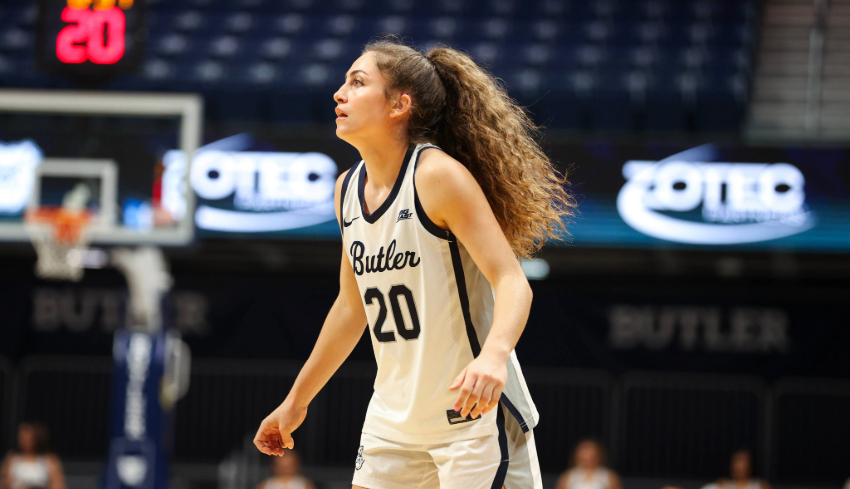
To a spectator in Hinkle, there is nothing out of the ordinary about sophomore guard Karina Bystry. Like the rest of the women’s basketball team, the guard plays the game at a high speed, is not afraid of shooting the ball and has settled well into a team full of new faces.
However, if one were to look closer, they would see that Bystry dons something the rest of the team does not — hearing aids.
Born with hearing loss, Bystry did not start wearing hearing aids until she was 10 years old, and she disliked them initially.
“Living with [hearing aids] is a little overwhelming because it amplifies everything,” Bystry said. “It’s like glasses; you’re tired of wearing them all the time [and] you just want to take them off. It was definitely an adjustment, it took almost 10 years for me to be fine wearing them.”
In scenarios where noises become overstimulating, such as a packed stadium during a game, Bystry can turn her hearing aids down to let less noise in.
“There’s some gyms that are very loud and cramped [so] the noises are just 10 times worse, but I can just turn my hearing aids down a little and it lowers the frequencies, so it’s not as [much of] a headache,” Bystry said.
Despite growing up in an accepting community, no one understood all the intricacies of living with a hearing impairment. However, she had two role models that helped instill confidence in her. One was Tamika Catchings, a former forward for the Indiana Fever. Catchings was also hearing impaired and wore hearing aids throughout college and her 14-year career in the WNBA.
The other was her older brother, who grew up with hearing loss as well. Seeing him be able to make friends and play basketball inspired Bystry to do the same, and she says growing up in a similar scenario to him gave her a sense of normalcy.
While learning how to live with hearing aids, Bystry also had to adapt to wearing them on the court. In a fast-paced game like basketball, it was easier said than done.
“Basketball is very chaotic and everything’s just happening all at once,” Bystry said. “It definitely took me a long time to finally understand the cues, like to look at [my] coaches because I won’t be able to hear it. I have to tell myself, ‘You gotta look at Coach, you gotta look at the team, you can’t rely on the sounds only.’”
The backing of her coaches and teammates helped ease her into wearing hearing aids as a player. Her teams made sure to adjust their communication methods so that Bystry understood everything clearly, even during the heat of the game.
“They always make sure to get my attention [and] be like, ‘Hey, this is the play,’” Bystry said. “When I was a kid, my coach used to wear [a Phonak microphone], speak into it and it would go in my hearing aids. [Now], the coaches usually just make signs [and] tell me to look at them after certain things happen so [I] know that they need my attention to tell me the play.”
These adjustments led to Bystry taking large strides as a player. Last season, as a first-year at Northern Kentucky, the guard averaged 14.8 points per game. She led all Division I (D-I) first-years in free throws made and attempted, and tied the Northern Kentucky record for most three-pointers made by a first-year.
Even though head coach Maria Marchesano was unaware of Bystry’s hearing impairment until moments before formally meeting her, Bystry’s skill left no doubt in Marchesano’s mind that she wanted the guard on her team.
“My assistant [coaches] said they knew from playing against her last year because they saw the hearing aids, but I never noticed them,” Marchesano said. “She was about to visit campus, and five minutes before she got here, somebody said something about her being deaf and I was like, ‘Wait, what?’ They’re like, ‘Yeah, you didn’t know that?’, [and] I was like, ‘No.’ That’s a very important detail when you’re recruiting somebody, [and] I found out minutes before she came on her visit. … Even once I found out, I never was like, ‘Oh, I don’t want to recruit this kid.’ I was even more impressed with who she is and what she does because she’s a pretty good player.”
Now, the Bulldogs have incorporated different ways to communicate instructions from the bench. Sophomore Destiny Macharia, one of the team’s point guards, occasionally uses non-verbal methods to indicate plays.
“When I’m dribbling up the floor, if it’s a simple call, I try and sign it when I’m coming up [or] I repeat it as loud as possible,” Macharia said. “[If] we have a call that uses numbers, I’ll try and do the numbers on my hand. We all try to repeat calls, especially on defense when a lot of things are going on very fast, [and we try to] emphasize it so we can help [Bystry] out.”
These small changes, Macharia noted, helps the team connect better overall.
“Adjusting to her hearing loss [is] different, but I think it actually helps with communication,” Macharia said. “I don’t think I’ve talked as much as I have [this year] in my whole basketball career. I think it’s very helpful because we need to communicate [more] as a team.”
Off the court, Macharia says the guard is one of the funniest people she knows, and is someone who never fails to put a smile on her face or boost her confidence. Macharia also notes that she has yet to beat Bystry in any shooting drill due to her relentless work ethic.
Her work ethic as a student does not go unnoticed by Marchesano as well, who calls Bystry a genius. The head coach says the guard is one of the most unique people she has coached, and has an interaction that she feels sums up Bystry’s personality to a tee.
“We kind of joke that she’s living a whole different life inside of her head that none of us get to see or know about,” Marchesano said. “I was listening to her talk to one of the other coaches the other day. She’s telling one of our assistants that she did well [in organic chemistry], but she wanted a 98 out of 100, which she already told all her friends, [and then she asked], ‘What are you going to be for Halloween? I think I’m going to do this. Are you guys handing out candy?’, and it was all one run-on sentence. She’s a character [and] so fun to be around.”
Bystry has not let her hearing impairment limit her in any way, and she shows no signs of slowing down. Currently, the guard is averaging 8.7 points and 2.7 rebounds per game. Bystry is also one of the team’s most accurate shooters, making 52.6% of her shots from the field and going 50% from three.
“For somebody that already made it that far in life to average 15 points on a D-I program, the sky’s the limit for her,” Marchesano said. “She’s not putting limitations on herself because she’s hearing impaired, she’s working just like any other D-I athlete would. You should see every player for who they are, because the fact that they’ve had to overcome things actually makes them even more impressive in my eyes.”
Growing up with a disability took some time to adjust to, but with the help of her family, coaches and teammates, Bystry has grown more sure of herself over time. Now, the guard is confident that she can take on any challenges that arise.
“It’s a disability, but I don’t see it as a disability,” Bystry said. “There’s always an assumption that if you have something different, there’s something wrong with you and you’re weird. As I grew up, I learned to [stand] up for myself, and I think hearing aids helped me gain my confidence, which also translated [over] to basketball. Because it’s part of my identity now, I love it and it makes me different from other people, so I feel a little special at the same time. It definitely was hard, but if I can overcome this, there’s [nothing I can’t] overcome.”