
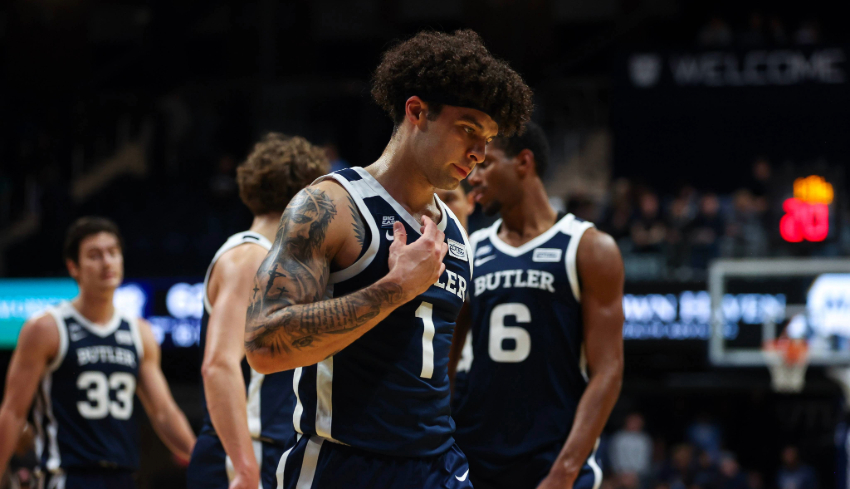
A crowd of 7,345 fans packed into Hinkle Fieldhouse to watch the men’s basketball team go head-to-head with Pitt. A strong start and a halftime appearance from newly inaugurated Butler Blue V brought good energy to the fans, but the Dawgs’ second half performance and subsequent 76-64 loss left nothing to smile about.
“We lost our offensive focus and identity,” head coach Ronald Nored said. “As a result, we allowed [Pitt] to start feeling good and participate in a game that we had under control.”
To Nored’s point, Butler held the lead and the momentum heading into the half after using three consecutive takeaways to fuel a late 9-0 run.
However, that offensive focus did get lost, and not in a small way. The Dawgs’ rhythm came to a screeching halt after the break, shooting a dismal 5-for-31 from the field. That mark was nearly doubled by their turnovers, of which the Bulldogs committed nine in the frame.
“We’ve got to do a much better job not turning the ball over,” junior guard Eduardo Klafke said. “That was one of the main focuses for us and we had 15 of them. That’s not good enough to beat a team like this.”
Turnovers were an issue, but not the only culprit. Butler shot 21% from three-point range, its second-straight struggle from beyond the arc. In addition, the fast-break game that provided 17 of the 42 first-half points yielded nothing in the second half.
For Nored, the underwhelming showing leads to one point of emphasis: habits.
“I did not think our habits were there offensively for a full 40 minutes,” Nored said. “This is just about habits at the end of the day. We have to practice, watch the film and understand when and where our habits did not show themselves. We’ve got to continue to make sure our habits show themselves consistently.”
While Butler has a couple of buy-games coming up, the urgency to install those habits grows with every game, as does the list of concerns. At the top of the list is the Bulldogs’ frontcourt situation.
Sophomore Samis Calderon drew the start at forward against the Panthers, unseating incumbent junior Treyson Anderson, who had started each of Butler’s first three games. While limited in his offensive skills, Calderon’s inclusion was primarily to serve the defense, which worked well.
“Samis does a great job defensively and gives us a lot of versatility,” Nored said. “I thought that [starting] lineup looked good.”
However, scoring is the real problem in the frontcourt.
Senior center Drayton Jones, now a two-year starter for the Dawgs, has been quiet all season long, averaging just 4.5 points per game. A slice of the blame for that can be pinned on the team’s perimeter-first philosophy. The rest goes to Jones and his teammates being consistently out of sync on rim-runs, typically Jones’ most effective form of offense.
When that connection is not working, Butler’s interior offense commands little respect.
The same can be said for Anderson’s minutes at the five, only for a different reason. As a floor-stretcher, Anderson’s best scoring comes from beyond the arc. That can make him a valuable resource when he and his teammates are both knocking down shots.
When they are not, however, having a good shooting day, the story changes. Anderson becomes a redundancy, providing little to no threat of interior scoring or a backdown game. He is best served playing alongside a true center like Jones who can provide that post-scoring dimension, but Nored did not feel comfortable playing them together due to their prior defensive issues.
“We’re still gonna play the two bigs together,” Nored said. “Tonight it didn’t work itself out, but we’re still working through all those lineups … So nothing is set in stone. It can change again.”
As Nored points out, this rotation is not necessarily here to stay, but it illustrates an ugly Catch-22 that the Dawgs will have to find solutions for if they want to salvage a successful season.