
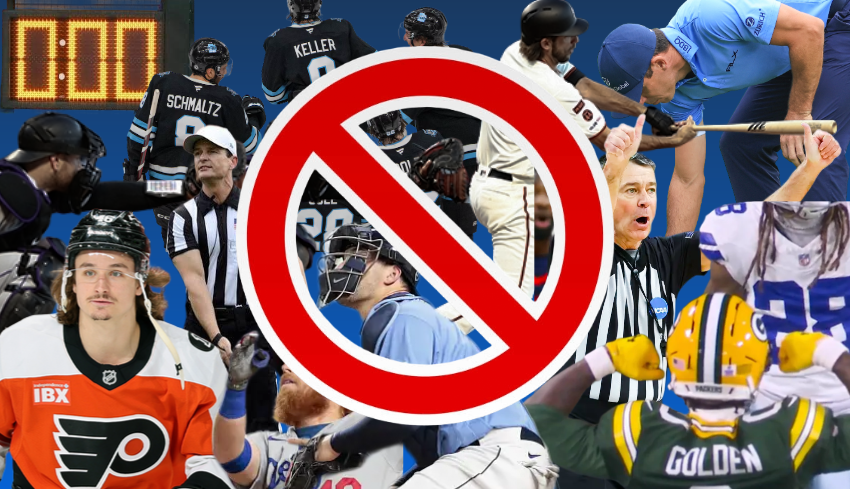
Whether it is to improve the flow of the game or to uphold uniform standards, every sports league has a lengthy rulebook that seems to receive a new entry every season. With so many regulations, there are bound to be unpopular ones among fans. Here are some rules the Collegian thinks should be changed, altered or removed entirely.
NHU-HAN BUI | SPORTS EDITOR | hbui@butler.edu
Hockey — Tuck rule
A penalty being called on a player is annoying enough, but when the penalty is for something that has no effect on the game, it gets even more frustrating. The NHL installed the tuck rule back in 2013, stating that players cannot have their jerseys tucked into their pants. Players would receive an initial warning on the first offense, and then be dealt a minor penalty for delay of game the second time. Despite the rule being in the league for so long, Philadelphia Flyers center Trevor Zegras has been the only player to be penalized for it in 13 years.
Many players, such as Zegras, have been tucking in their jerseys for years, and in a league full of superstition, being penalized for something you have done without fail for so long can create discomfort. If it has no real standing on the game or on safety, players should be allowed to wear jerseys how they like.
JAMIE HEALY | ASSISTANT SPORTS EDITOR | jdhealy1@butler.edu
Golf — Preferred lies
An unfortunate trend on the PGA Tour in recent years has been the increasing number of rounds played under preferred lies, also referred to as “lift, clean and place”. While the tour amended the preferred lies relief rule before this past season — granting only a scorecard-length relief instead of the full club-length — it is not enough. Golf is an outdoor sport and weather conditions sometimes force this rule to be in place, however it is used far too often. For example, all four rounds of the 2026 CJ CUP Byron Nelson were played with preferred lies even though the course had just undergone a renovation. Tour golfers are the best in the world because they can adjust their strategy and hit the best shot possible at any given time. Not every tournament needs to be a birdie-fest. Perhaps the PGA Tour can take a page from the United States Golf Association during the U.S. Open and force the players to have to play the ball down even in the toughest conditions.
CALEB MCLAUGHLIN | STAFF REPORTER | cpmclaughlin@butler.edu
Basketball — Possession arrow
In basketball, when two players are tied up for the ball at the same time it is called a “jump ball,” but in college basketball, the term is practically irrelevant. In the NBA, when a jump ball is called, the two players will meet at the free throw line or half-court — depending on which is closer — to participate in a jump ball, but in college basketball they settle for a possession arrow. The possession arrow needs to be changed for many reasons. For example in 2013, Wichita State was down three in the Final Four to Louisville. With six seconds left, Louisville missed a free throw and Wichita State initially came down with the rebound. However, a Louisville player forced a tie-up and the Cardinals retained possession because they had the arrow. In the NBA, it is fair since whoever wins the tip gets the ball, but in college, one player can hustle his tail off for basically nothing. The possession arrow is less fair than a simple jump ball — therefore it needs to be abolished from all levels of basketball.
MARGARET LAMB | STAFF REPORTER | mclamb@butler.edu
Football — Taunting rule
The NFL’s taunting rule has completely ruined the energy of the game. Right now, if a player makes a great play and spins the ball, flexes or just looks at an opponent for a second too long, the refs immediately throw a flag for a 15-yard unsportsmanlike conduct penalty. Giving the other team 15 free yards and killing the momentum after a massive gain over a celebration is absurd. What makes it even dumber is that the NFL allows entire teams to do choreographed dances in the endzone, but when an individual player is hyped up after a good play, he is penalized. A little trash talk does not hurt, but letting the refs blow their whistles and punish players for excitement ruins the thrill for people watching. Football is an intense and emotional sport, so forcing players to act mundane after making a great play ruins the vibe of the game. The NFL should drop this rule and let players show their personality in addition to their otherworldly talent on the field.
BROOKS BAKER-WATSON | STAFF REPORTER | bbakerwatson@butler.edu
Football — Intentional grounding
A bunch of annoying things happen in any given football game, but none are as irritating as when a quarterback — who should be held dead to rights by a pass rusher or two — evades his pursuers long enough to scramble out of the pocket and throw the ball way out of bounds. So far out of bounds that a receiver has no chance to make a catch, but the beer-sipping fan in section 108 does. That tactic is a not-so-well-kept secret among quarterbacks to not commit intentional grounding; a rule in collegiate and professional football that forbids them from throwing an incomplete pass on purpose when faced with defensive pressure. However, that penalty only applies to quarterbacks who are still within the pocket, not those who leave the “tackle box” and then decide to throw a bad ball. If pressure is coming, instead of trying to make a play, the quarterback chooses to throw it way out of bounds for no penalty. But if you ask me, I think it is a cheap move; throwing the ball away to no one, no matter the quarterback’s position on the field, should result in intentional grounding.
ROCCO SANTORO | STAFF REPORTER | rsantoro@butler.edu
Baseball — Universal designated hitter
The MLB is starting to make baseball not baseball. Modernization started during the COVID-shortened season in 2020 when pitchers hitting were replaced with a designated hitter — something that had existed in the American League since 1973. Pitchers batting made the two leagues different and added unique strategy for the teams, and an additional home-field advantage for National League teams. The addition of a universal DH, along with an expanded postseason, is changing baseball for the worse. If the MLB wants to add tradition back into their sport, it starts by letting pitchers hit in the National League again.
COLE SPIEGEL | STAFF REPORTER | cispiegel@butler.edu
Baseball — Pitch clock
The 2023 MLB season brought some major rule changes that have significantly impacted gameplay in a negative way. With the addition of the pitch clock rule, a thirty-second timer between batters was implemented, and a timer was also implemented between pitches — fifteen seconds with the bases empty, and twenty seconds with runners on base. The timer was later reduced to eighteen seconds with runners on base starting in 2024. While the supposed “benefit” of this rule change is to create a quicker pace of play during games, this change is not an improvement at all. A large part of the charm that comes with attending an MLB game is not what actually happens on the field — rather, it is what you can enjoy and take in off of it. There is no MLB game that can truly be enjoyed or fully “taken in” in just two hours. Maybe, the so-called “fans” who are calling for shortened MLB games were never true fans in the first place. The MLB should abolish this rule in order to fully enhance the fan experience once again.