
On Nov. 6, Project 44 will host Tip-Off, their annual three-on-three basketball tournament, at the Health and Recreation Complex (HRC). The event will raise awareness about a former Bulldog’s legacy and the need for stem cell donors. There, students will be able to become registered donors via swabbing, and the tournament winners will receive Pacers tickets.
Project 44 is named in honor of Andrew Smith, a former Butler Bulldog who wore number 44 on the 2009-2012 basketball team. Smith tragically passed away due to leukemia in 2016. In his honor, Project 44 was launched shortly after.
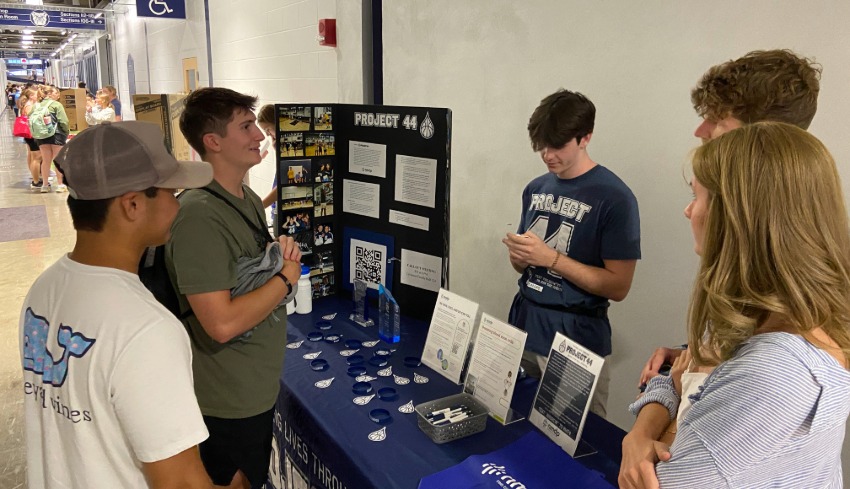
Students may have seen the organization tabling at various athletic events. At many of these events, students will have the opportunity to be swabbed for a DNA sample. That sample is then registered into the National Marrow Donor Program (NMDP), a database of donors ready to help patients needing a stem cell or bone marrow transplant.
Jackson Houldsworth, a senior finance and marketing double major, serves as president of Project 44. He spoke about the safety and simplicity of the swabbing process.
“There’s a lot of misconceptions about [the process],” Houldsworth said. “I have gone and seen the place where they process those swabs, and it’s very secure … [if] you get reached out to and you don’t feel comfortable with [donating], then you can always say no.”
Not everyone who is swabbed will match with someone in need of stem cells. When there is a match, donors usually go through a process called peripheral blood stem cell donation, which is similar to donating blood or plasma. Stem cell donors prepare by taking injections in the five days leading up to their draw to release stem cells into the bloodstream.
A machine draws blood from one arm, filters out the stem cells and returns the rest in a process that usually takes around four to six hours. The NMDP estimates donation requires between 20 and 30 hours over a four to six week period, which includes the time donors spend on the phone, scheduling appointments and the donation process itself.
According to the NMDP, peripheral blood stem cell donation is the most frequent method of donating stem cells and is used more than 90% of the time. The other 10% of cases require bone marrow donations, where donors go under general anesthesia while a doctor collects marrow from their hip bone using a syringe. Donors are able to go home after the anesthesia wears off. The NMDP also covers all the expenses for donors, including their travel to and from the procedure.
With Ronald Nored taking charge as the new head coach of the Bulldogs, Project 44’s mission hits home harder than ever. Nored played three seasons with Smith, adding another connective layer between the organization and the team.
Many current members of Project 44 have longstanding personal connections to the cause. Houldsworth spoke about his grandfather, the founder of NMDP, and what it means to him to be able to work in tandem with the organization.
“My family is still heavily involved with NMDP,” Houldsworth said. “I just attended their gala a couple weeks ago, [and] it’s really cool seeing other people’s stories. They just recently hit 150,000 lives saved too.”
Sophomore marketing major Kanoa Gahl similarly spoke about his passion for the organization and his desire to help make a difference, even before arriving on campus.
“I was lucky enough to get to meet Andrew Smith before he passed,” Gahl said. “Coming [to] Butler, [the] first day I stepped on the campus I knew what Project 44 had done and what kind of organization it was, and I wanted to be a part of it and I wanted to serve as much as I could … in honor of [Smith].”
The key to Project 44’s mission is an expanding registry of donors at the ready. Stem cell and bone marrow transplants require a genetic match between the patient and donor’s Human Leukocyte Antigen markers.
Smith’s own passion for the bone marrow registry grew when he learned about the barriers that ethnically diverse people experience when trying to receive organ transplants. One of the ways to combat this inequity is to increase diversity in the donor population.
Junior health sciences major Kaylee Hauger echoed the need for a wide variety of participants in the registry.
“There are millions of people that need transplants, but … it’s really rare for their DNA to match with a recipient,” Hauger said. “We have so many people in the registry [and] it’s rare in general for someone to get matched.”
The annual Project 44 Game at Hinkle Fieldhouse will be held in Smith’s honor on Feb. 11. Students interested in participating in the Tip-Off tournament can sign up on the Fusion Play app.