
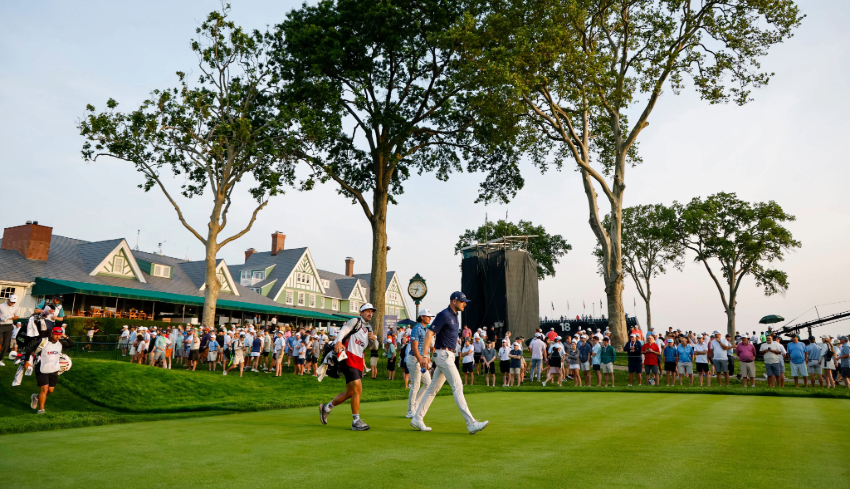
Matt Vogt is no ordinary dentist.
Not only does he spend his time co-running a dental practice — The Dentists at Gateway Crossing — Vogt is also an accomplished amateur golfer, qualifying for the U.S. Open in 2025, winning the Indiana State Amateur in June and reaching the semifinals of this year’s U.S. Mid-Amateur in early October. Additionally, Vogt is a former member of the Butler men’s golf team. During his three semesters on the team, his scoring average was 77 his first year, good for third on the team and 77.5 his second year, second-best on the team. However, he left the team midway through his sophomore year and graduated from Butler with a degree in biology before enrolling in Indiana University’s dental school.
This week, The Butler Collegian sat down with Vogt to discuss his experience at Butler, lessons he learned through his golf career as well as balancing life between his family, dental practice and golf.
THE BUTLER COLLEGIAN: Can you talk about that decision to come to Butler and what your initial experience was like on the team?
MATT VOGT: I was an up-and-coming junior golfer, but really wasn’t worth much in junior golf or when it came time to get recruited to play college golf, but I knew it was something I really wanted to do. I loved the game and wanted to play at the next level. I didn’t have that many scholarship opportunities, truthfully, to play Division I golf. I sent out my resume [and] DVD of my swing to as many coaches as I could kind of randomly and got a call from Butler. [I] made the drive over from Pittsburgh where I was born and raised, and immediately fell in love with the campus. The fact that [Butler is] a basketball school helped and I didn’t go on any other official visits. That was the only one, and we said, ‘This is right’, and the rest is history.
TBC: You finished third and second respectively in scoring average during your two years on the team. How easy, if at all, did the game seem at the time and what did you learn really about that experience of playing collegiate golf that you’ve applied to your current game?
MV: It was actually very hard adjusting to life away from home. My parents had gone through a recent divorce. Adjusting to the rigors of being a college athlete and trying to succeed academically was very difficult. I chose to walk away from the team after three semesters. I was just at the point where, looking back on it, I just wasn’t really prepared for the college student-athlete experience. I wasn’t mature enough and I think it was the right decision at the time. [It also] taught me to come back and just love the game of golf. I feel very grateful [for] all the tournament golf that I’m playing and all the recent success. I’m so appreciative of being able to play the game of golf because I’m back to playing it for the love of the game and I think that’s a great place to be and it lends itself to playing well. I feel very fulfilled in the game of golf now at this point in my life.
TBC: Having watched you qualify for the U.S Open in 2025. I was captivated by your story, not only a dentist qualifying for the national championship, but a caddy returning home. Was there any part of you at Butler that could have ever dreamed of that, or even any part of when you were a junior golfer?
MV: Gosh, never. I never had aspirations to play professional golf. It legitimately never crossed my mind. I didn’t feel like I was good enough. Maybe I didn’t dream big enough [but it] truly never crossed my mind. Before I left for Walla Walla for sectional qualifying, I was talking to my coach and close friend of mine, and I did tell him, ‘I think I can do this’. So there was some belief that I could achieve that awesome dream of playing the U.S Open that built up over the past [few] years. But certainly never when I was a junior golfer, even at Butler. I would have never, ever dreamt in my wildest dreams that I could do that.
TBC: Correct me if I’m wrong, but you also were a former basketball player in high school too, right?
MV: Yeah, after quitting the golf team and really wanting nothing to do with golf for the rest of my time in college and early on in graduate school, [I helped] start a club basketball team at Butler. A lot of us were probably guys who could play [Division II or Division III] but certainly weren’t going to be on our basketball team at Butler. And it was awesome. We loved getting better and being active. It was such a fun couple of years where we formed that club basketball team. It kind of reinvigorated me a little bit, to step away from golf, but still be competitive. And then I came back to golf being in better shape and being more athletic and hitting further from working with the club team. It was a really fun time. I looked back really fondly on that and still stay in touch with a lot of those guys.
TBC: You qualified for the U.S. Amateur at Merion this year as well. How have those opportunities shaped you as you look back on where you were when you were burnt out of the game in college?
MV: Merion’s such a special place. Like instantly you walk on the grounds and you’re like, ‘This is special. This is different’. To miss match play there by the skin of my teeth was super, super disappointing, but I feel like I learned something from every experience. Golf is a crazy game and pretty much everybody besides the guy who wins is going to be disappointed in some respect.
So, you do have to pick and choose lessons and positives from everything that you’re doing, even when it’s not going well and you’re not scoring well, you have to find learning experiences and positives or this game will just destroy you. I think that’s where my perspective has changed since college. Being an 18-year-old who knew nothing, who just lived and died with every single shot and everything, every single result [compared to] this point in my life, I feel like golf has its rightful spot in the perspective of my life. I love God. I love my family. I have a career and like golf certainly fits into that as a priority, but not more important than all those things. So that’s kind of how I think golf has changed in my life over the years for the better.
TBC: Reflecting on your college career and where you are now, what advice would you have for any athlete who may not turn pro, or may be a little burnt out of the game in college but still loves the game?
MV: The perspective that I would share is that I think the healthiest relationship you can have with athletics at any point in your life is to do it for love of the process of improvement, of competition, the love of just pouring yourself into something to get better, to see what’s possible in your craft, whether that’s golf or another sport.
It’s hard because we measure ourselves in sport by wins or losses, but I think if you live and die with wins and losses or your identity is sunk into winning and losing, you’re just bound for disappointment [and] frustration. For a lot of people in high-level sport, [where] their livelihoods or maybe their future careers depend on those results, it’s kind of a catch-22 where the more you focus on results and the more you focus on getting your fulfillment out of winning or losing, the less successful you’ll probably be. I think that’s the perspective that I would pass on at this point in my life.
TBC: You mentioned this a little while ago. Your priorities now are God, family, your career and then golf. How hard is it to achieve that balance? Was there a specific time or moment you had to reevaluate how you approached your career and your golf practice or whatever?
MV: I think for anyone in mid-amateur golf, life goes on. It’s just a constant balancing act and you go through seasons, right? I went through a season of life in the last week and a half at the Mid-Am where that was my focus. Then obviously that changes when I get back home. So it’s just a constant balancing act. It’s trying to not let one of those things get too far out of whack. That can be hard or easy at certain times. I’ve been fortunate in that I can have some flexibility in my career and in my practice to take time when needed to go play in the U.S. Mid-Am or something like that. But it’s just trying to constantly find that balance and not let [my] priorities get out of whack.
TBC: Have there been any lessons you’ve learned from golf and how it’s played a role in running your practice, being a dentist in general or opposite? Is there anything you’ve learned from your professional career that you’ve applied to your own amateur golf career?
MV: Absolutely. This is something that I think a lot of young people struggle with and we learn as we get older, but in golf and in dentistry, working in healthcare, sometimes in [very] high pressure situations, you’re forced to be very level headed. Being overly reactive or overly emotional is not a good thing. We get in pressure situations [in] dental implant surgery, just as we do trying to make a crucial putt on the golf course. There are absolutely similarities. So I think reacting and thinking as neutrally as possible in high-pressure scenarios is something that has benefited me in dentistry, running a business and also trying to perform at a high level on the golf course.
TBC: I just want to take a second because I know you mentioned your family. What role have they played in not only your dental career, but in your amateur career and helping you find balance between the two?
MV: God bless my wife. When I was starting my practice in 2018, not taking an income and starting a brand new business, she was supporting us. It was just [the two of us] at that point, but she was supporting us. I’ll always be eternally grateful for that.
And then as time has gone on here, she’s a saint. Anytime I’m out on the golf course or trying to perform, I do feel like it is a team effort where she supports me. She knows that I’m doing this for the love of it, certainly not to make an income or anything. It would be impossible to do what I’m doing without her support at home. As a result [of knowing] she is rooting for me and holding down the fort with our two young kids, [it] gives me more freedom to go try my best at a tournament. I’m just so grateful for her and her support. And I try to return the favor about priorities not getting out of whack. It’s so important to me that when I’m home, I’m home and being a loving husband and father.
TBC: You also won the Indiana State Amateur in 2026, setting a scoring record. What did you feel going into that week and how did you make sure to carry that momentum through the mid-am this past week?
MV: A theme of this summer and this year for me was trying to validate to myself that [last year] wasn’t a fluke, [to] work really hard, keep a level head [and to not] get an inflated ego just because of one cool thing happening. That’s kind of the mindset I took into the Indiana Am and just into the year in general. I was feeling great going into that week at the Indiana Am. I knew I could go out there and win that golf tournament. It was just like a real focus on my process and taking it shot by shot, not getting too far ahead of myself and it turned out to be a great week and I still had to escape in a playoff. No matter whether it’s the state [amateur] or some random tournament locally, it’s hard to win golf tournaments, so I’ve really enjoyed that one and it felt really good to join that list of state champions.
TBC: You talked about not getting ahead in your process and not trying to take anything for granted, especially after qualifying for the U.S. Open last year. Is that different from the approach you would have had 15 years ago?
MV: There was no process. Golf is such a humbling game. The process of improvement in golf is not exciting. It’s pretty boring on the surface. It’s just repetition [in] getting the most out of the time that you have. I’d say just like being confident in a process and sticking to it is definitely something that wasn’t what was going on in 2009 [when] I was on the Butler team.
TBC: Are there any hopes or aspirations you still have in the amateur game and advice you might give to an aspiring golfer?
MV: I’ve said this before in some interviews, but for me, it’s just keep going. Keep loving the process, keep loving the competition. Keep your wits about you and have perspective on where golf falls in your life ultimately. I would encourage [people] to do the same, you know, whether they’re playing golf, whether they’re playing tennis, whether they want to build the best paper airplanes in the world. Do it for the love of love of what you’re doing. Do it for the fulfillment of a craft. [Don’t do it] to compare yourself to others [and don’t] worry about whether people think what you’re doing is stupid or silly in their eyes. If it’s something you want to do, do it for yourself and do it for the love of the process, not for results or accolades or other’s approval.
TBC: If you could put hitting the first tee shot of the U.S. Open at Oakmont into words, what was that experience like looking back at it now?
MV: I was feeling pretty good after my warm-up. [I thought] let’s see what happens, you know? Let’s play some great golf. I remember when I teed the ball up [and] when they announced my name and heard the applause, everything instantly changed. I went to tee up the golf ball. My hand was shaking so violently that it was very hard to get the ball on the tee. And I teed the ball up a little too high. So I went to adjust it a little lower and my hands [were] still violently shaking and at some point I just said, ‘Well, we just got to get this over with’. Not the best mindset for the first shot at a major championship, but it is what it is.
I didn’t play as well as I would have hoped that week or to my capabilities, I would say, but the experience is invaluable. I mean, sure, there were tons of pressure moments at the U.S. Mid-Am last week, but what could top [the pressure of the] first tee at the U.S. Open? There’s not a whole lot of things. It’s been an invaluable experience for me to just continue to grow as a player and as a person.
TBC: Having qualified for the U.S. Open last year and going through that experience of local and then final qualifying, is that something you would want to do again?
MV: Absolutely. As long as [my] priorities always stay straight, why not try? Golf is so funny. You just have to try. Golf will humble you. You will fail more than you succeed in golf, but you will never know unless you try. That’s something I tell to a lot of people, not just amateur golfers [but even] buddies playing club golf.
At any level, you have to push yourself out of your comfort zone. You have to try to qualify for that thing. You have to fall on your face. You have to shoot 80. You have to go through that process of growth. You just have to build on your failures or build on your experiences over and over and over again. I’d love to play in another U.S. Open. But to have expectations about how the future will go is just setting yourself up for failure. So just keep going, keep trying and see what happens.
TBC: If there’s one thing that you could say to your 19 or 20-year-old self, when you were considering quitting the golf team because of burnout compared to where you are now, still having love for the game, what would it be?
MV: I’d say it would be to look at the game of golf specifically on a long-time horizon, look at the big picture. There’s so many ways to enjoy golf and sport in general into your adult life that don’t involve playing professionally.
When you’re in a college sport and maybe there’s pressure to win or pressure to play at a higher level, it can feel very binary, like you either win or you lose. But knowing what I know now, I have just formed so many great relationships, so many great friends. I feel like I’ve been able to positively influence so many people through golf. I’ve been able to go to so many cool places and do so many cool things, and I would say that even without the tournament success. That’s all because of this game that we love. I wish I could go back to [my 19-year-old self] and tell that guy to just enjoy the game [and] enjoy the process. It’s kind of cliche, but that’s how you’re going to get the most out of your skill and also be able to get fulfillment out of the game of golf.
TBC: Finally, how often do your patients ask you to play?
MV: There’s a good chunk of patients who know about my [hobby], what I’m doing when I’m not helping them with their teeth and they are very supportive and interested and it’s just fun. I mean, we got to find something to talk about besides teeth all day. So if they want to talk golf, great. There’s also a chunk that probably has no idea [about my golf game], and that’s cool too. I’m not there to use golf to grow my practice. I’m not there to just do the bare minimum and then go goof out on the golf course, you know? When I’m there, I’m there to help people. And it’s been a really cool synergy. It’s been very neat to just feel the support of patients. It’s been almost a decade in that practice now and I have formed a lot of great relationships with people. It’s pretty cool to feel like you’ve got a lot of support in pursuits outside the office. Dentists are people too.