
Members of the Butler community are achieving extraordinary things, both on and off campus. From first-years to alumni to administrators and back, each Bulldog has a story to tell. Read on to discover the next of our Bulldogs of Butler through a Q&A style interview.
Senior lecturer Jeana Jorgensen, PhD has spent the past 13 years cultivating safe spaces for Butler students and setting them up for success through what one might call unconventional teaching methods. Jorgensen received her Bachelor of Arts in interdisciplinary studies with a focus in folklore from the University of California, Berkeley. She also earned her master’s and PhD from Indiana University in folklore studies.
Jorgensen is teaching two sections of her first-year seminar Fairytales, Self and Society, as well as AN 302 The Body and Society this semester. Beyond teaching, she enjoys baking and Middle Eastern dancing in Indianapolis. The Butler Collegian sat down with Jorgensen to learn more about her passion for folklore and how she integrates it into her curriculum.
THE BUTLER COLLEGIAN: Tell me about why you decided to study folklore.
JEANA JORGENSEN: In my first semester at UC Berkeley, I took a freshman seminar on fairy tales, [an] introduction to cultural anthropology, [an] introduction to linguistics and [an] introduction to religious studies. By the end of that semester, I was like, ‘I want all these things put together as one thing forever,’ and that’s kind of what studying folklore is. It’s all the parts of life and culture that we get passed on, not through institutions or top-down hierarchies, but peer-to-peer and face-to-face. Folklore dies out when it’s not relevant anymore. By studying it, you will always study what people actually care about, even if they wouldn’t have put it in those words.
TBC: What is your favorite class that you have taught here?
JJ: Last semester I taught one of my favorites, which is an anthropology upper-division class called Women, Gender and Folklore. That’s a fun one because we look at images of women in folklore, like myths, legends and fairy tales.
We use feminist and queer theory to interpret folklore and understand the gender roles that are present in all of our lives, and maybe flying under the radar because sometimes you’ll look at a commercial or an ad and be like, ‘Oh, well, that’s really sexist,’ … But we don’t always pause and analyze our daily folklore with the same lens as we might apply to pop culture. So it’s a really fun way of reframing things that are in our daily lives that might have a lot of messages about gender and sexuality.
TBC: What do you enjoy most about teaching?
JJ: I like teaching because I’m fundamentally optimistic about human nature. I think that if people can learn, they will learn. I think that education is a tool of liberation. I think that any time there’s a movement to keep people ignorant or to keep books out of people’s hands, that’s a tool of repression.
I think that people who are educated may not make all the same choices because we have different lives and [have] different values, and that’s okay. But we’ll make more informed choices, which is important when you live in a voting democracy. I really think that people can use education to better themselves, [and] you learn to appreciate the arts and other cultures and other languages. Yes, you learn stuff for your career, and that’s super important, but I think it [also] makes us so much more well-rounded, and it’s such a great opportunity.
In the classroom, I really love seeing students have those ‘Aha!’ moments where they realize a connection between something in the class and something in their lives. I don’t plan my classes to be all about random stuff that I just like. I plan [them] to be about stuff that’s relevant to everybody’s lives.
TBC: What inspired you to create and teach FYS 101, Fairytales, Self and Society?
JJ: I wanted this to be relevant to students. I structured the class where the fall semester is learning the history of classic European fairy tales because it teaches us to question what we know.
We start with questions about what people do in times of global pandemic historically, and so we read parts of ‘The Decameron’ — a 14th-century Italian frame tale about what people did in Florence during the Black Plague. [At the time,] storytelling and folklore were the primary ways that people not only entertained themselves, but also imparted moral lessons and had ethical debates and things like that.
I also [wanted] to talk more about not only gender and sexuality, but also race and ethnicity. I wanted to bring in more questions of ‘Who has power? Who has authority?’ So we also read ‘Cinderella Is Dead’ by Kalynn Bayron, which is a dystopian Cinderella retelling with a Black queer protagonist basically fighting for her rights.
I really wanted to amp up the relevance and show that despite how many people think fairy tales are ‘just for kids’ or they’re trivial or whatever, we have actually used these forms of storytelling during really difficult periods of human history, and we can use these kinds of storytelling to ask important, human questions.
TBC: What is something few students or faculty know about you?
JJ: I have a sourdough starter. I haven’t bought yeast in over a decade. I make bread, focaccia, pizza, waffles [and] crackers with my sourdough starter. I like to cook. I like to bake.
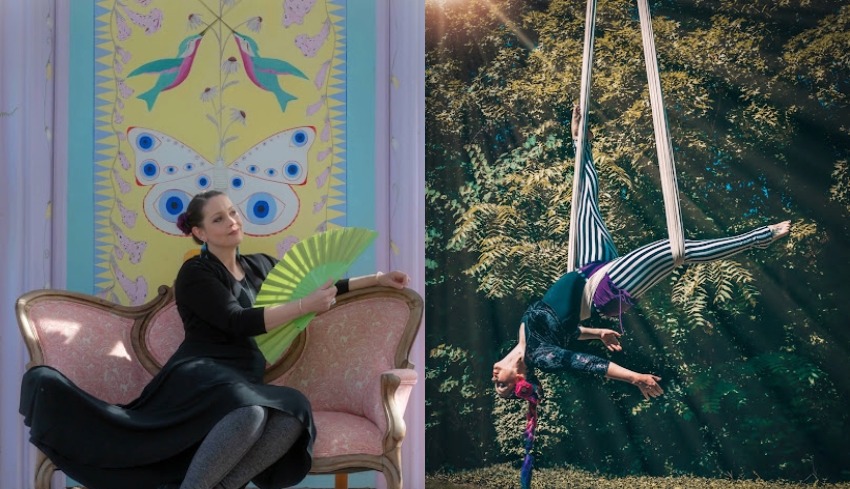
I’m also a professional dancer, so I teach and perform Middle Eastern dance — aka belly dance — all around town with my troupe and as a soloist, and I do aerial dance. In fact, I have a sprained toe right now from that. I go to a studio called Suspended Animation that’s actually not far from campus at Michigan Road and 86th Street. You all should check it out, it’s really fun.
TBC: How did you get started with belly dancing?
JJ: Growing up, I was actually a tomboy, and I played a lot of soccer and read a lot of sci-fi novels. At some point, I went through puberty, and I was like, ‘Oh, I have hips. This is gross. I don’t like this body that I have,’ but growing up in LA, you’re exposed to a lot of different cultural things. There was belly dancing at the Renaissance Faire, at the Moroccan restaurant, at the Greek festival, so it was kind of on my radar.
In high school, I took a class at a local community college that was just an intro to belly dance, and I was like, ‘Oh, this is fun, oh, I’m good at this, oh, having hips is actually a good thing in this dance form.’ So I just stuck with it and sort of explored different styles and broadened my understanding.
TBC: Is there anything else you would like to share with the Butler community?
JJ: I’ve been teaching my FYS on fairy tales since fall 2020. I think it’s had a good run. I’m considering debuting next year an FYS on romantasy. I might also retool it as an upper-division 300-level class in anthropology to ask questions about world building, culture, gender, sexuality [and] relationships.
I’m one of the first scholars to publish on ‘A Court of Thorns and Roses’, so I feel like I have a lot to say about it, and I feel like we could use these books. I’m about to read ‘Fourth Wing’. We’re going to use these books to ask questions about how we represent romance and how we represent the ideal relationship and things like that.