
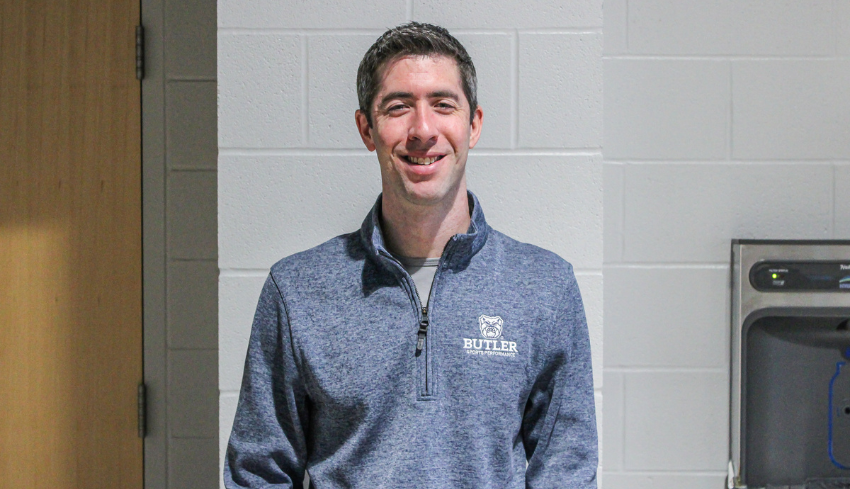
A former collegiate swimmer himself, mental health director Brian Tremml has transitioned out of the pool and into the minds of Butler athletes.
For Tremml, the switch was inspired by a desire to be a guiding hand for athletes struggling with the mental challenges of college athletics.
“I was really drawn to the mental side of performance,” Tremml said. “It was something that I struggled with a lot as an athlete, and then as a coach [I] tried to help athletes work through that as well.”
As the first mental health director employed by Butler Athletics, it was up to Tremml to determine the ins and outs of his role himself. While it was no easy task, he did what he does best: focus on mental stability and a calm attitude.
“I think it’s like any type of externally stressful event,” Tremml said. “I could view it as a threat, or I can view it as an opportunity. There were certainly some moments of doubt [and] uncertainty, and just having to work on myself internally as well, to give myself grace as I go through this and build it out.”
Among the responsibilities Tremml took on outside of straight-up therapy was mental skills coaching in a group setting. Co-head coach Tari St. John and the women’s soccer team were quick to utilize this service, establishing a weekly session as soon as Tremml officially started at Butler.
St. John feels that not only did her team bond in its meetings with Tremml, but that the growing familiarity created a feeling of trust with him.
“Immediately, the team really gravitated and looked forward to those meetings,” St. John said. “[They] took on board some of the things that he provided in a team setting. As a really healthy byproduct, we had him involved, and so they got to see him and hear his voice on a weekly basis, and it just made the friction that much less to go see him individually.”
Discretion and ease of access to Tremml are key within the athletic department. His office hides in plain sight in the concourse of Hinkle Fieldhouse, with athletes able to schedule appointments with him by scanning one of the many QR codes hanging up around the building.
For the athletes, having access to a mental health professional in the same building where many of them work out and practice is a step towards kicking the stigma associated with seeking therapy or other mental help.
Chad Gabbard, the associate athletic director for student-athlete health, performance and well-being, believes that Brian’s help will stick with his clients far after they move on from Butler.
“The stuff that Brian teaches and educates our students on, I think it gives them lifelong lessons of how to be successful when they leave here and understanding that there [are] people here to help you,” Gabbard said. “It’s okay to say, ‘Man, I’m not okay.’”
In addition, Dr. Keith Magnus, the director of counseling and consultation services, believes that a male presence in the mental health sphere may have a positive impact on the male athletes’ idea of mental health help.
“If you’re a male athlete, you’re in that [sports] culture, [and] there’s not much space for feelings or struggling at all,” Magnus said. “So to have a mental health professional that identifies as male, I think for some it probably does open that door [into improving your mental health].”
Many former athletes — including St. John and Tremml himself — are left pondering how their college experiences may have been different with more mental support.
“I think about that all the time, not just for my performance, but for my life,” Tremml said. “I think that helps me make meaning out of the role. Now I get to kind of fill a role that I wish had been there for me.”
Not only does Tremml provide therapeutic guidance, but he also supports the teams on game days, with St. John noting her appreciation for his consistent attendance.
Tremml’s calming nature and effortless relatability as a former athlete give him a profound understanding of what current Bulldogs are going through and the journey they have been on to become a Division I athlete.
“The modern student athlete, their sport and their identity is usually intertwined,” Tremml said. “It kind of has to be. You wouldn’t get to this level without having sacrificed a lot of who you are.”
While Tremml no longer gets to mentally prepare and look forward to race days of his own, he can find comfort in the positive effect he has had on student-athletes across Butler.