
Overtime, or “OT,” is an opinion column series where The Collegian takes national sports headlines or polarizing topics and gives them a Butler-centric angle.
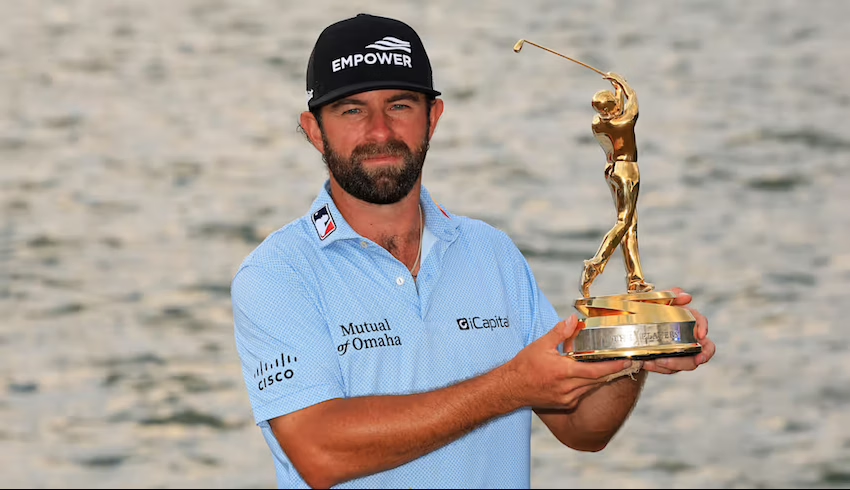
The 2026 Players Championship concluded on March 15 with Cameron Young rallying from a four-shot deficit at the beginning of the final round to outlast one of the strongest fields in golf, filled with major winners and rising stars.
In addition to the outstanding test this year’s championship proved to be, it was the promotion leading up to the event from the tournament organizers and the PGA Tour that caught the attention of many golf fans. Commercials advertising the event contained the tagline, ‘March is going to be Major.’
While the Tour has tried to position The Players Championship as a fifth major for years, this marketing campaign ignited a mostly negative fervor in the golf world.
It is important to note that the PGA Tour does not run the four men’s professional golf major championships. The Grand Slam events of The Masters, PGA Championship, U.S. Open and The Open Championship are instead organized by Augusta National Golf Club, the PGA of America, the United States Golf Association and the Royal and Ancient Golf Club of St. Andrew’s respectively.
The PGA Tour has already elevated the event to match the four major championships in terms of FedEx Cup points, so the tournament gives an equal number of points to the winner as they do to a winner of any of the four major championships.
The Players Championship also has one of the largest amounts of prize money given, with $25 million divided among players in this event, and $4.5 million going to the champion.
However, the PGA Tour’s beliefs about the event’s status do not coincide with the views of many golf enthusiasts.
Sophomore biology major Sarah Konosky believes the approach the Tour is using does not come from the fans, but it stems from the it’s desire to gain a foothold in the audience’s view of golf and the Tour’s role in the sport.
“It seems like the push for it to be a major championship is very much a corporate-driven [idea],” Konosky said. “I do not believe it represents what the golfers or even the fans want.”
In a survey conducted by Golf Digest, two dozen tour players were polled on whether The Players Championship should be considered a major championship. The overwhelming majority responded that The Players is not a major in their view.
Additionally, the PGA Tour still maintains its policy of not letting players currently signed to the LIV Tour compete in PGA Tour-sanctioned events. Previous winners of this event, such as Cameron Smith, Phil Mickelson and Sergio Garcia, were not allowed to participate as a result.
Senior neuroscience major Grant Gilsenan asserted that the absence of big names from the LIV Tour and the PGA Tour’s reluctance to let them compete in the Tour’s marquee event are some of the reasons the Players should not be seen as a major championship.
“Bryson DeChambeau did not play in The Players, for example,” Gilsenan said. “Not having the biggest names in golf from both tours hurts the championship. The four majors we have currently have all the best players in the world competing, no matter the tour.”
The Players Championship has maintained its status as the biggest non-major event for players and fans alike because of its exciting and signature venue that hosts the tournament each year.
TPC Sawgrass has hosted the event since 1983 and is famous for its 17th hole, which is an island green. The hole has been the site of multiple memorable moments over the years, including Tiger Woods’ ‘better than most’ putt that led to victory in 2001, in addition to Rickie Fowler’s remarkable effort in 2015, where he birdied the hole three times on Sunday to eventually win in a playoff.
Currently, only The Masters is held at the same location each year. The other three majors move to different courses annually, ensuring that fans get the chance to see iconic courses challenge the world’s best.
If The Players were to be elevated to major status, the course is likely to stay the same, as TPC Sawgrass was built primarily to host this event.
However, the issue of legacy becomes a factor if the event is considered a major championship.
Sophomore biochemistry major Nate Elliott contended that if the tournament is promoted to major championship status, fans and players alike will have to judge if a modern player is truly greater than an older player, given that they will have more chances to win more major championships.
“Players back then and even now played the event as important but not as legacy-defining as a major championship,” Elliott said. “It would not feel the same historically.”
It is more beneficial for The Players Championship and the PGA Tour to recognize that the tournament is incredible in its own right and does not need to be promoted as one of the Grand Slam events, but instead as an opportunity to add to a golfer’s legacy and perhaps, as a springboard to future success in the four major championships.
For example, the last two winners of the event — Scottie Scheffler in 2024 and Rory McIlroy in 2025 — both went on to win the Masters a month later. Furthermore, last year’s runner-up, J.J. Spaun, recovered from his heartbreaking playoff loss to McIlroy to dig deep and survive a challenging test of golf at the U.S. Open last June.
The tournament also has a much shorter history than the four major championships, which hinders the Tour’s argument for major championship status.
The Players Championship has only been contested since 1974, while the Masters is the youngest major championship, as it was first held in 1934. Meanwhile, the PGA Championship dates back to 1916, while the U.S. Open and the Open Championship trace their beginnings back to 1894 and 1860, respectively.
As the biggest non-major event in professional golf, The Players Championship has carved out its own distinct place in the game, where golfers see where their game is before heading off to Augusta for The Masters. If promoted to major championship status, the tournament risks losing its identity.